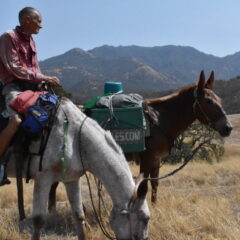
Mystery Mule Man Spotted Around San Diego – And his Journey Might Change How You See the World

At the end of May, we were notified about an article that SanDiegoVille wrote about us 3 Mules. The article was titled “Mystery Mule Man Spotted Around San Diego – And his Journey Might Change How You See the World.” We don’t know who wrote the article since no name attached. It sort of sounded like an AI written article. Below, we have crossed out the inaccuracies and provided correction in bold font.

Many have reported seeing him in the past week – an older man walking the streets of San Diego with a mule in tow, sparking curiosity and social media buzz. But who is he, and what exactly is he doing? It turns out he’s not homeless, lost, or part of a stunt – he’s on a decades-long mission that challenges the very way we live.

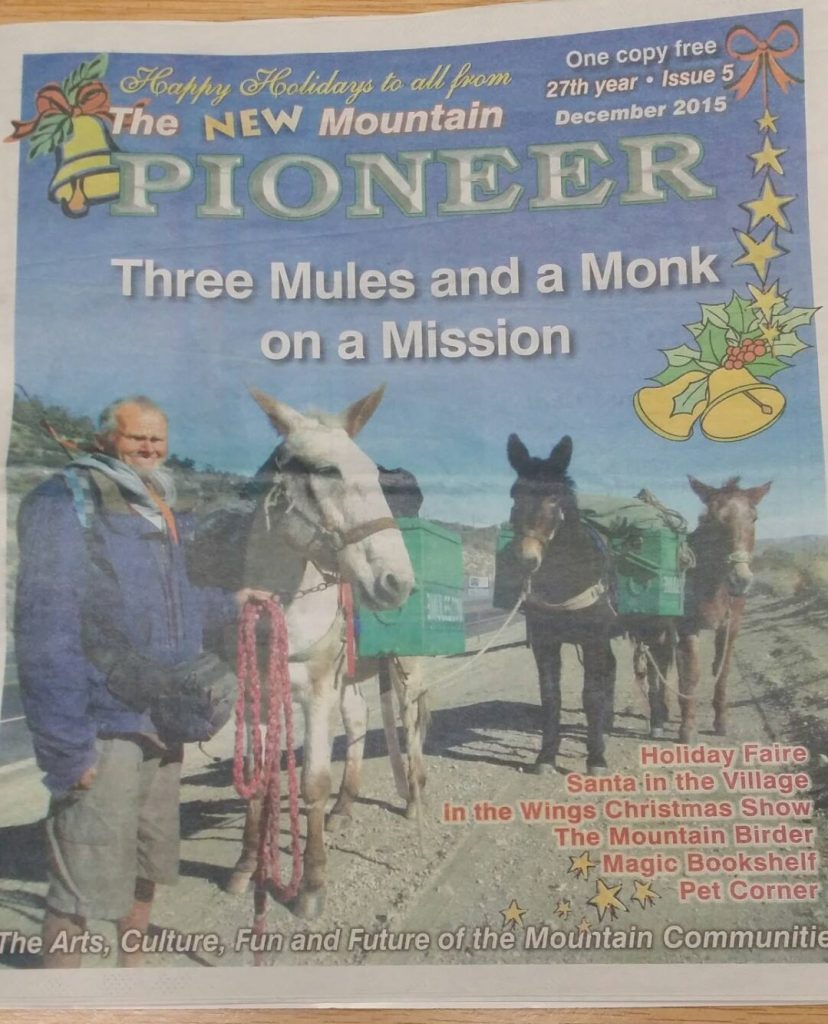
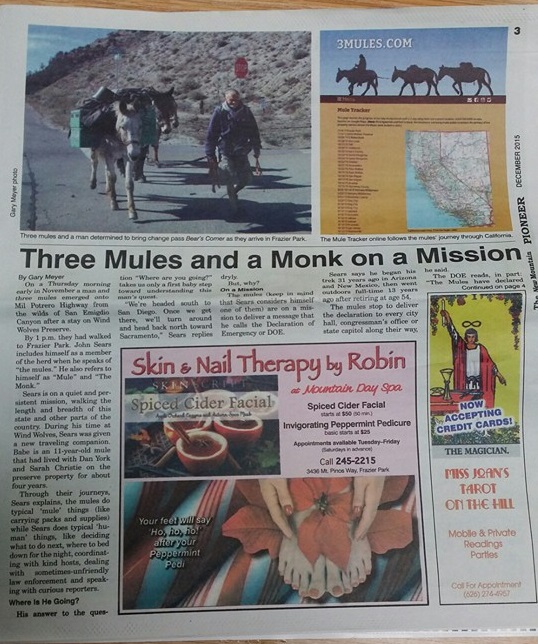
San Diego residents may have recently spotted a man walking alongside a horse mule along the streets from Oceanside to Chula Vista and everywhere in between. He’s not lost, nor is he simply passing through – he’s living a way of life that predates freeways, smartphones, and suburban sprawl. The man is known as “Mule,” and his journey is part of the decades-long 3 Mules Project Journey – a nomadic mission through the American West to promote a life of simplicity, environmental awareness, and the sacred right to move freely across public lands.

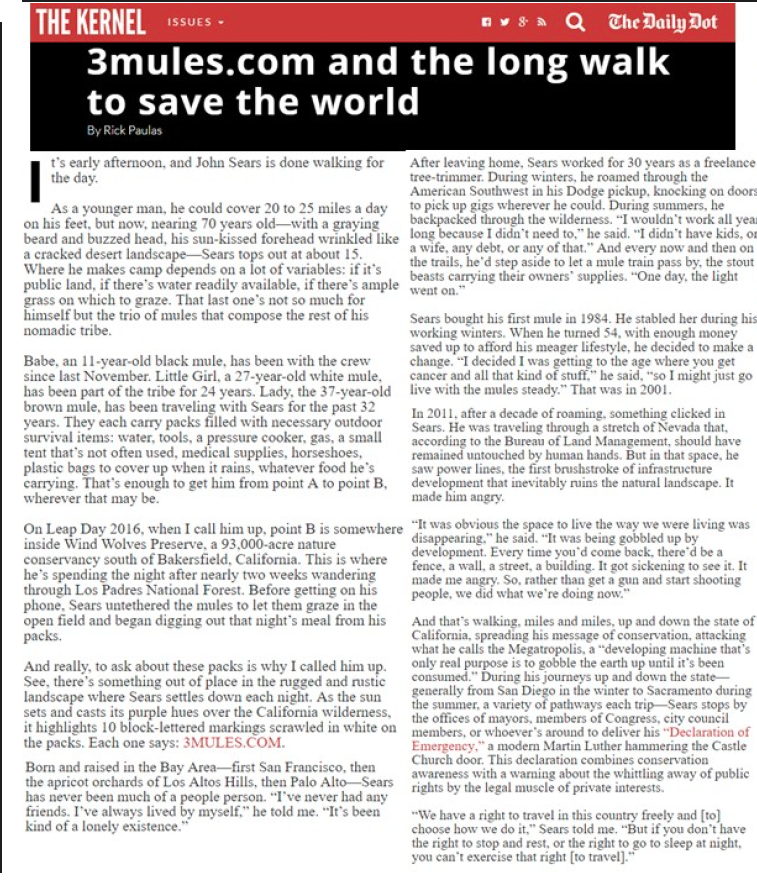
Now in his late 70s, Mule (who also goes by Monk) has lived outdoors full-time with his mule companions for more than 35 40 consecutive years with 22 of those 40 consecutive years doing nothing else other than the sacred act of walking with his mule companions. Together, they travel by foot, covering 5 to 20 miles a day, depending on food, water, and terrain. They’ve migrated up and down California for decades, following seasonal cycles – south to San Diego in the winter, then back north through the Central Valley and up to Sacramento during warmer months.

Their presence may seem anachronistic, even eccentric, to passersby accustomed to the pace and priorities of modern urban life. But to Mule, his animals, and a growing number of followers (over 64,000 on Facebook alone), this lifestyle is a form of resistance against the encroaching sprawl he refers to as “the Megatropolis” – the unchecked spread of concrete, development, and car culture that has consumed open spaces and limited access to nature.

The 3 Mules Project Journey isn’t a performance or stunt. Mule lives entirely outdoors, foraging for food, relying on donations of oats and vegetables, and sleeping wherever he can find a quiet place that won’t land him in legal trouble. That’s harder than it sounds. California’s laws often prohibit overnight camping on public land, leading to occasional arrests and citations. He’s even been jailed and briefly committed to a psychiatric facility, as happened during an arrest in Gilroy. His mules were sent to a shelter, and he was locked up for six days before a patients-rights advocate intervened.  

Still, Mule remains committed to what he calls the “sacred act of walking,” which he believes is essential not just to individual well-being, but to the health of the planet itself.

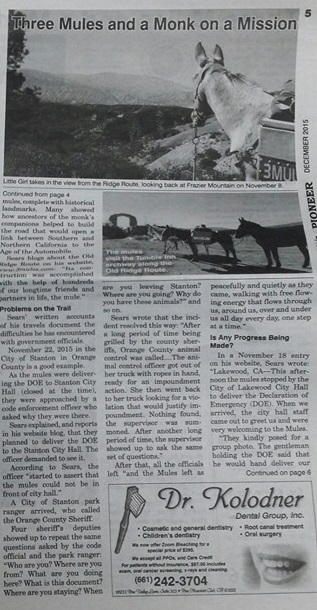
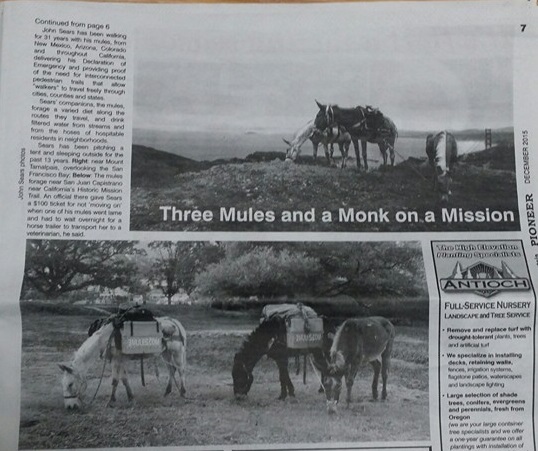
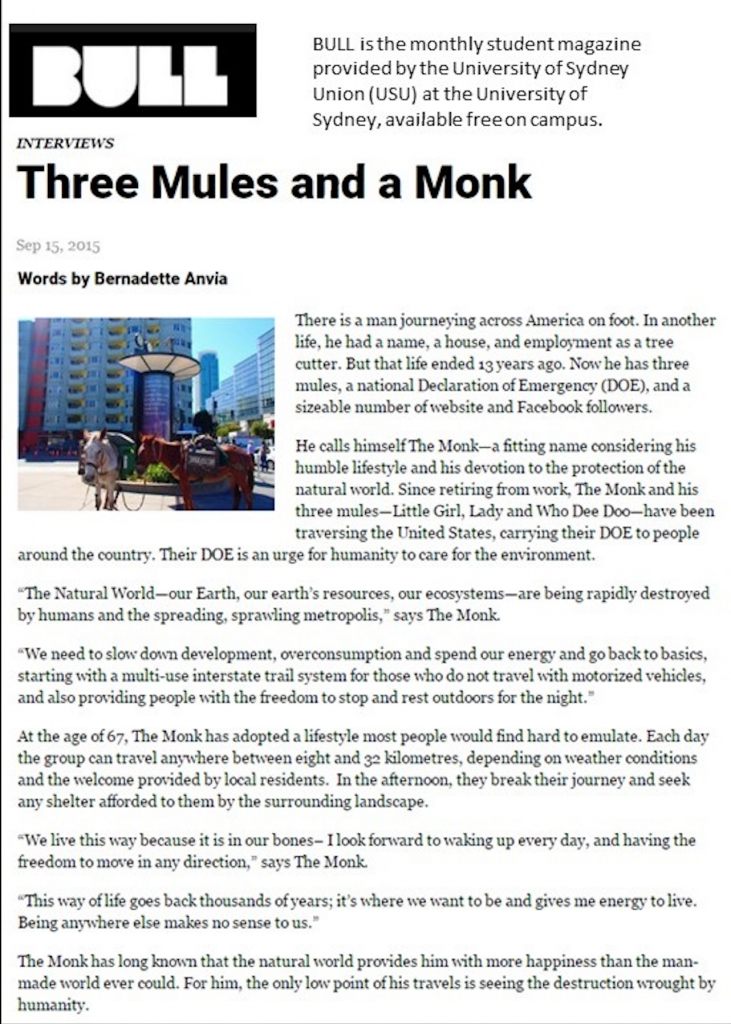
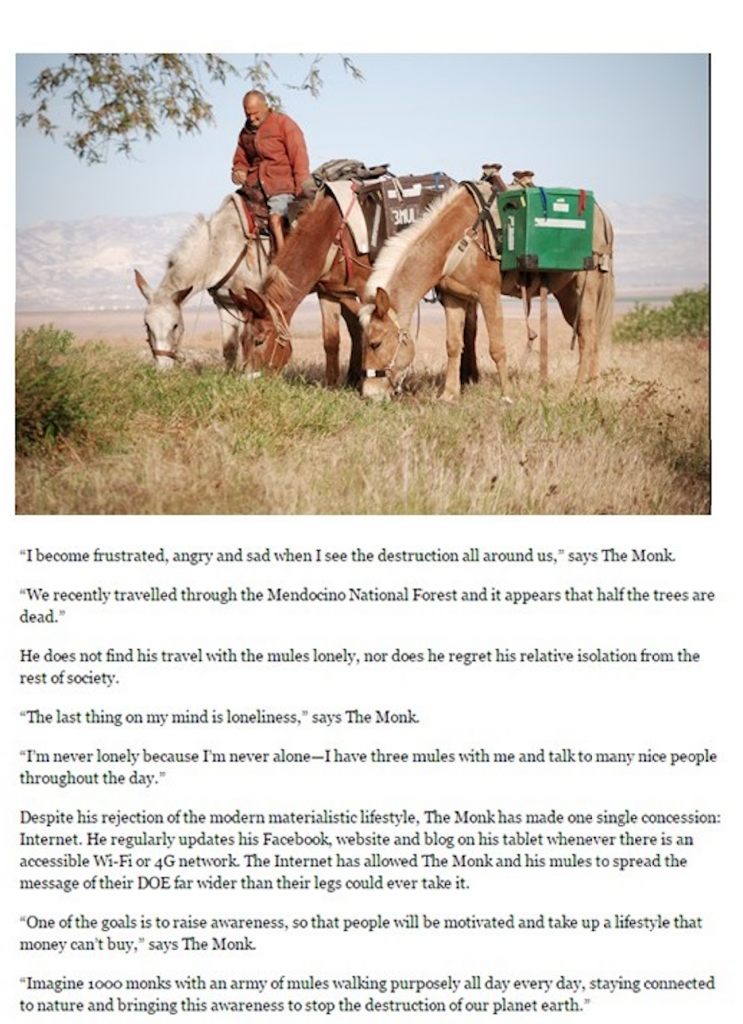
Mule travels with the help of his equine companions, most recently a sorrel molly mule named Rosie. Over the years, other mules – Little Girl, Lady, Little Ethel, and Leroy – have come and gone, retired or passed on, but each has been part of the journey. The mules carry gear and food and graze along roadsides and fields. Mule is careful to stay within animal welfare guidelines, ensuring his mules carry no more than 20% of their body weight and are well-fed, hydrated, and monitored for health issues.

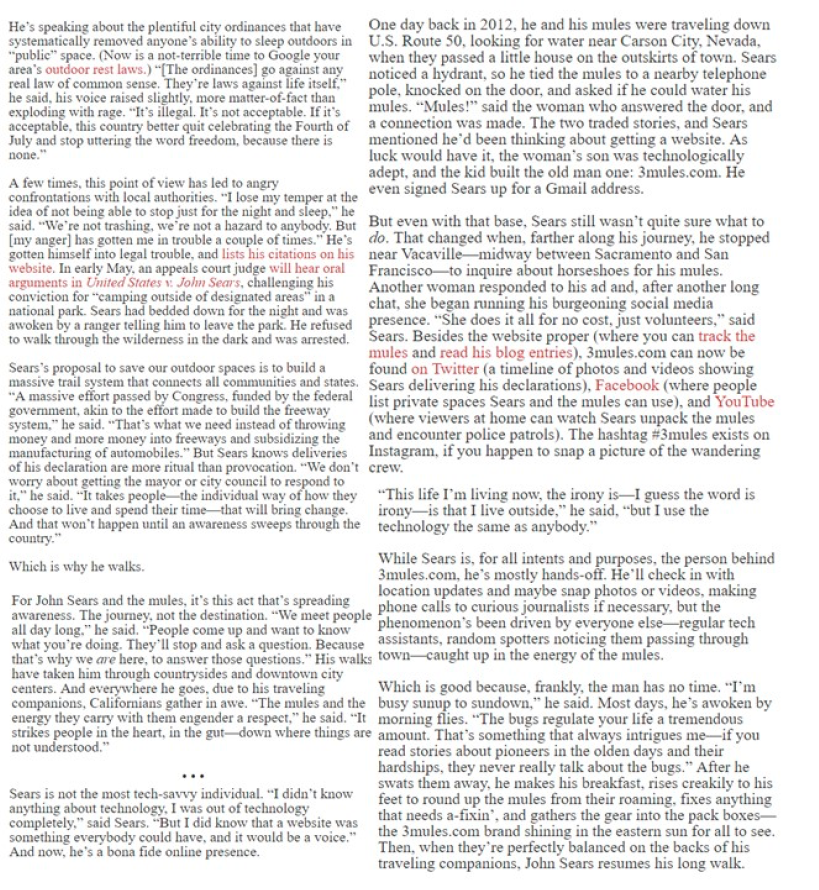
Though many assume he’s homeless, Mule insists that he’s simply “from the outside.” He doesn’t live in houses or drive cars. He exists in and with nature, embracing unpredictability, open space, and a sense of spiritual purpose. His lifestyle has drawn praise and admiration online, with thousands of followers tracking his movements and mission on the 3 Mules Facebook page and website. Some stop to offer food or water, or invite him to rest on private land for a night. Others report him to authorities, concerned about the animals or simply confused by his presence.

He’s walked the boardwalks of Venice Beach, slept under BART stations in Oakland, and traversed vast stretches of wilderness on Bureau of Land Management territory, where he’s witnessed suburban sprawl eat into spaces once left untouched. Two years ago, Mule walked the 295-mile stretch from Las Vegas to Ely, Nevada, only to turn back west when he realized how much land was disappearing. Twelve years ago, Mule was driven to walk out of Nevada, enter California, and bring the nomadic way of life into the heart of the California megatropolis. That moment shifted his focus – from wandering the wilderness alone to speaking up about the loss of public space.

Despite frequent interactions with police, Mule maintains that he stops on public lands only to rest at night for a period of less than 24 hours. He doesn’t set up permanent camp or collect garbage. “We’re not homeless. Our home is the Earth,” he says.

Mule’s attorney, Sharon Sherman, who represented him the Mules pro bono in 2013 was intrigued by the legal and philosophical implications of his way of life. “There is always a balance between people’s freedoms and the needs of a community,” she said. “Mule really made me stop and think about issues I’ve never considered before.”

For Mule, the right to walk freely is not just personal, it’s universal. “Why do you have more rights in a car than if you are walking?” he asks.

The San Diego appearance is just one stop on a continuous migration that Mule says he’ll continue “as long as he can.” And while his mission is unconventional, its message resonates with timeless urgency: to protect the natural world, to move with intention, and to remember that freedom is not something to be taken for granted – it’s something to be lived, one step at a time.

For more on the 3 Mules Project, visit 3Mules.com or follow their journey on Facebook and Instagram.

Originally published on May 29, 2025. Revised with corrections by the 3 Mules on June 6, 2025.
Share this:

The Mules sue the California Highway Patrol over their right to travel on the public thoroughfare

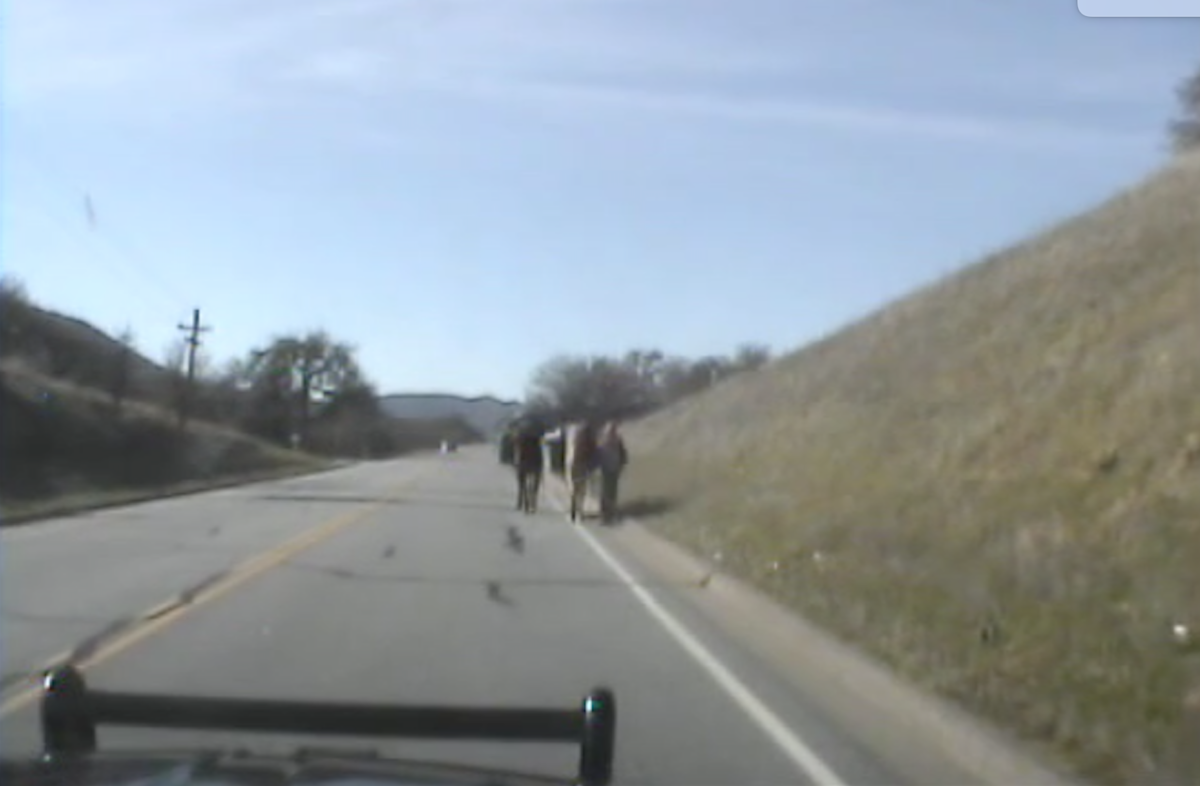
CHP dash cam shot of 3 Mules walking along Naciemento Lake Road prior to their arrest on January 23, 2020.

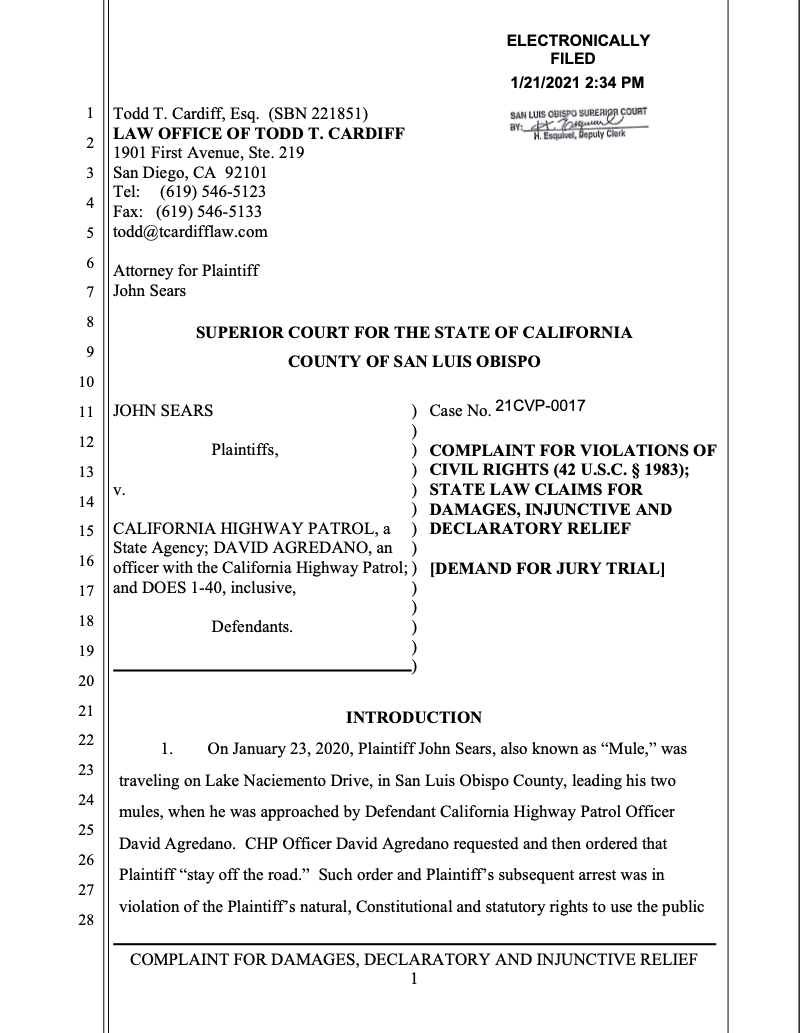
San Luis Obispo, CA: On January 21, 2021, John Sears, who lives a nomadic lifestyle and has traveled the state of California with his mules for the past eight years, filed a lawsuit in San Luis Obispo Superior Court alleging that the California Highway Patrol wrongfully and illegally arrested him in violation of his natural, Constitutional and statutory rights.  

As noted in the first paragraph of the complaint: “By this action John Sears seeks to protect this ages-old nomadic way of life and the sacred relationship between man and horse to travel together with reverence and respect for this beautiful place in which we all reside called Earth.”

Sears, 73, and his mules began traveling when he was 36. He has lived full-time outside and traveled with his mules after retiring from his work as a tree trimmer in 2001 at age 54. He documents their endless journey on his website 3Mules.com, 3 Mules Facebook and Instagram pages, which have over 60,000 followers worldwide. 

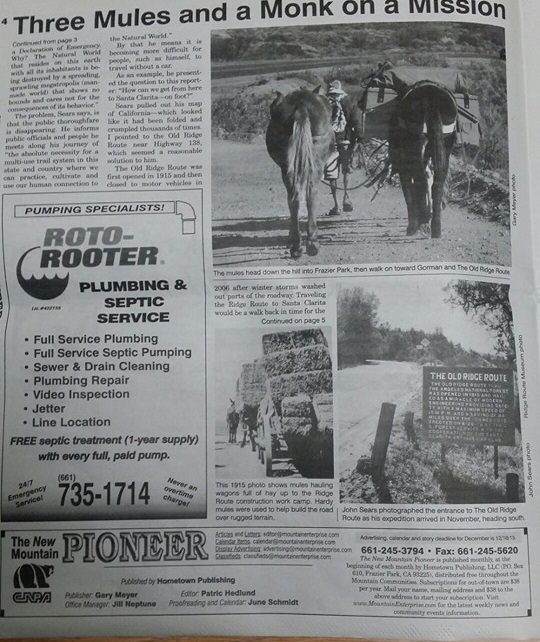
On January 23, 2020, the Mules were walking along Nacimiento Lake Drive, a rural two-lane country road near Paso Robles in San Luis Obispo County.  Such route is the only route between Bradley, California and Paso Robles other than Highway 101, and is part of the Juan Bautista de Anza National Historic Trail, a historically designated trail that stretches 1200 miles from Nogales, Mexico, through the California desert and coastal areas in Southern California and the Central Coast region, to San Francisco. 

Despite the Mules right to travel such road, and all public thoroughfares in California, excluding interstate highways, he was ordered by CHP officer David Agredano to “stay off the road.”  Such order was not only impossible to safely comply with, it was in violation of Sears’ rights under the U.S. and California Constitution.  

Sears states: “Nowhere in the California vehicle code does it state that the public thoroughfare is for the exclusive use of the high speed heavy machine called an automobile.”

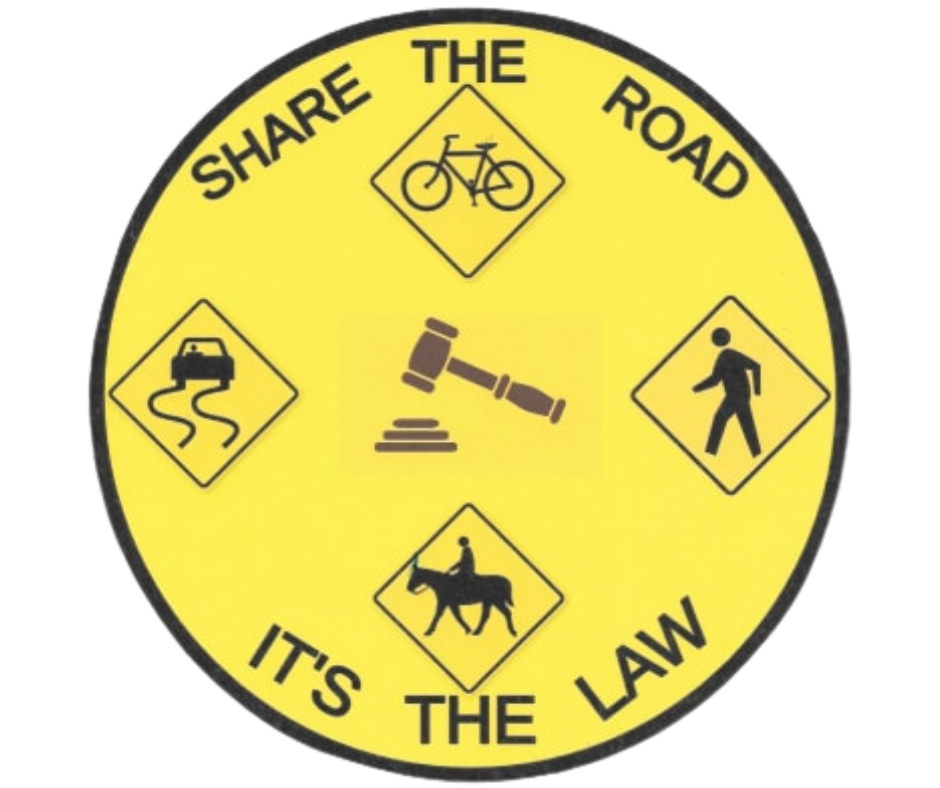
The California Vehicle Codes and Food and Agricultural Codes provide all non-motorized travel equal access to the public thoroughfare.  (Veh. Code § 21050, See also, Food and Ag Code § 16902, 16903.  

The driver of any vehicle approaching any horse drawn vehicle, any ridden animal, or any livestock shall exercise proper control of his vehicle and shall reduce speed or stop as may appear necessary or as may be signaled or otherwise requested by any person driving, riding or in charge of the animal or livestock in order to avoid frightening and to safeguard the animal or livestock and to insure the safety of any person driving or riding the animal or in charge of the livestock. “

California Vehicle Code 21759

Sears notes:  “The Mules were not creating a safety hazard. The Mules were legally using the public thoroughfare in conformity with the state vehicle code.  The motorist has one of two options: 1) obey the state vehicle code, slow down, and stop if necessary, when approaching livestock, or 2) disobey the state vehicle code, refuse to slow down, recklessly pass with no concern for the consequences, and call 911 to complain that there is a person walking with horses on the road.”

Along substantial stretches, Nacimiento Lake Drive is hemmed with steep banks on both sides of the road.  It has narrow to non-existent shoulders in many areas as the CHP dash cam video clearly shows.  The non-paved area directly adjacent to the road was a steep upward bank, which would be difficult to impossible for a pack mule to navigate.  

“The Mules were walking as close to the steep bank as we could to provide the motorists that were obeying state vehicle codes to safely pass.” 

Sears further notes:  “If this arrest was legal, then all U.S. citizens traveling under their own non-motorized power (equestrians, pedestrians, cyclists, wheelchair, and all others) is likewise illegal.  This nomadic lifestyle which the Mules practice, which is over hundreds of thousands of years old, is how the Mules live on this earth. The Mules are bringing this case to court to preserve the right for all equestrians, pedestrians, and cyclists to travel on these public thoroughfares without fear of arrest.” 

Sears filed a complaint alleging violation of his civil rights under Federal and California law, false arrest, and declaratory and injunctive relief.  In addition, to his damages, he seeks a declaration of his rights that he can present to law enforcement in the future, and for the CHP to issue a training bulletin informing officers of the right for equines and other animals to use the public thoroughfare.  

Mules-vs-CHP-p1

Image 1 of 15

People often ask the Mules what their mission is. “Our purpose is to walk and live peacefully taking only what we need. Seeking balance and harmony with all that surrounds us and bringing the energy and value of this ages old way of life to all of those who we pass.”

“Spiritually, we are all unique. The Mules are experiencing the sacredness of this place in our own unique way. We are not doing anything spectacular. We get up in the morning, fix something to eat, and walk all day long. We enjoy it. Just walking. We enjoy the sacred act of walking in harmony and balance with the energy of this beautiful Earth that flows in, around and through us.” 

 “The public thoroughfare has been designed for the high speed motorists and their automobiles,” Sears explained. “The Mules and those who travel under their own power and speed (equestrians, cyclists, hikers) must preserve the right to use these same public thoroughfares as there is no adequate trail system to get equestrians and non-motorized travelers from one community to the next in this state.”

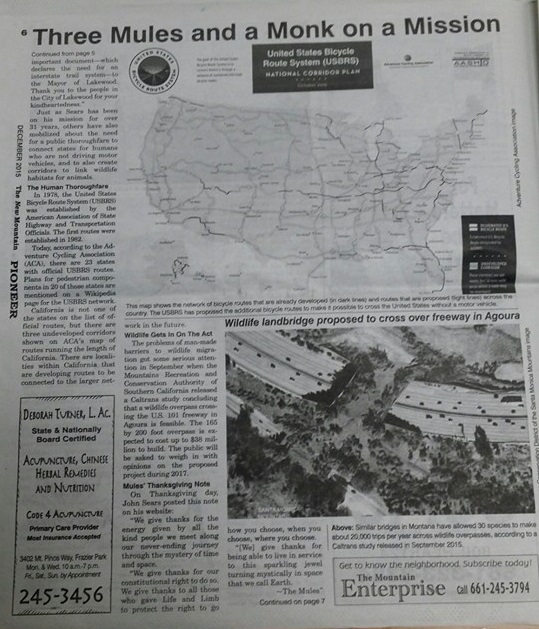
Sears has hand delivered copies of his Declaration of Emergency to over 200 city halls in California as well as to the governor’s office at the California State Capitol. In the declaration, he says the Natural World is being destroyed by a sprawling Megatropolis. Sears describes the Megatropolis as “the man-made world, spreading sprawling concrete, putting up lanes, putting up buildings everywhere. It wants all the remaining open space and it is unrelenting. It doesn’t want any other venues (pedestrians, cyclists, equestrians) to use the public thoroughfare except for its most favorite tool, the automobile.”

For further press inquiries or interviews, contact Attorney Todd T. Cardiff  Office (619) 546-5123 or Cell (619) 885-1443www.tcardifflaw.com

Share this:

Tustin, CA

As we were walking through Tustin, we stopped to graze on a grassy corner. After a certain amount of time, Tustin police appeared and we engaged in a friendly conversation. This is the same corner that we met them this past January. Orange County Register posted an article of that meeting

Share this:

KHSL-TV Action News Now interview with Cecile Juliette

On June 26, 2015 while we were outside Chico, Reporter Cecile Juliette of KHSL-TV Action News Now interviewed the Mules. We don’t have the original news clip. Here is the raw, unedited version of the interview that wasn’t aired that Ms. Juliette shared with us, which we truly appreciate receiving.


Share this: