At the end of May, we were notified about an article that SanDiegoVille wrote about us 3 Mules. The article was titled “Mystery Mule Man Spotted Around San Diego – And his Journey Might Change How You See the World.” We don’t know who wrote the article since no name attached. It sort of sounded like an AI written article. Below, we have crossed out the inaccuracies and provided correction in bold font.
Many have reported seeing him in the past week – an older man walking the streets of San Diego with a mule in tow, sparking curiosity and social media buzz. But who is he, and what exactly is he doing? It turns out he’s not homeless, lost, or part of a stunt – he’s on a decades-long mission that challenges the very way we live.
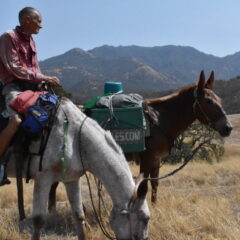
San Diego residents may have recently spotted a man walking alongside ahorsemule along the streets from Oceanside to Chula Vista and everywhere in between. He’s not lost, nor is he simply passing through – he’s living a way of life that predates freeways, smartphones, and suburban sprawl. The man is known as “Mule,” and his journey is part of the decades-long 3 Mules Project Journey – a nomadic mission through the American West to promote a life of simplicity, environmental awareness, and the sacred right to move freely across public lands.
Now in his late 70s, Mule (who also goes by Monk) has lived outdoors full-time with his mule companions for more than 3540 consecutive years with 22 of those 40 consecutive years doing nothing else other than the sacred act of walking with his mule companions. Together, they travel by foot, covering 5 to 20 miles a day, depending on food, water, and terrain. They’ve migrated up and down California for decades, following seasonal cycles – south to San Diego in the winter, then back north through the Central Valley and up to Sacramento during warmer months.
Their presence may seem anachronistic, even eccentric, to passersby accustomed to the pace and priorities of modern urban life. But to Mule, his animals, and a growing number of followers (over 64,000 on Facebook alone), this lifestyle is a form of resistance against the encroaching sprawl he refers to as “the Megatropolis” – the unchecked spread of concrete, development, and car culture that has consumed open spaces and limited access to nature.
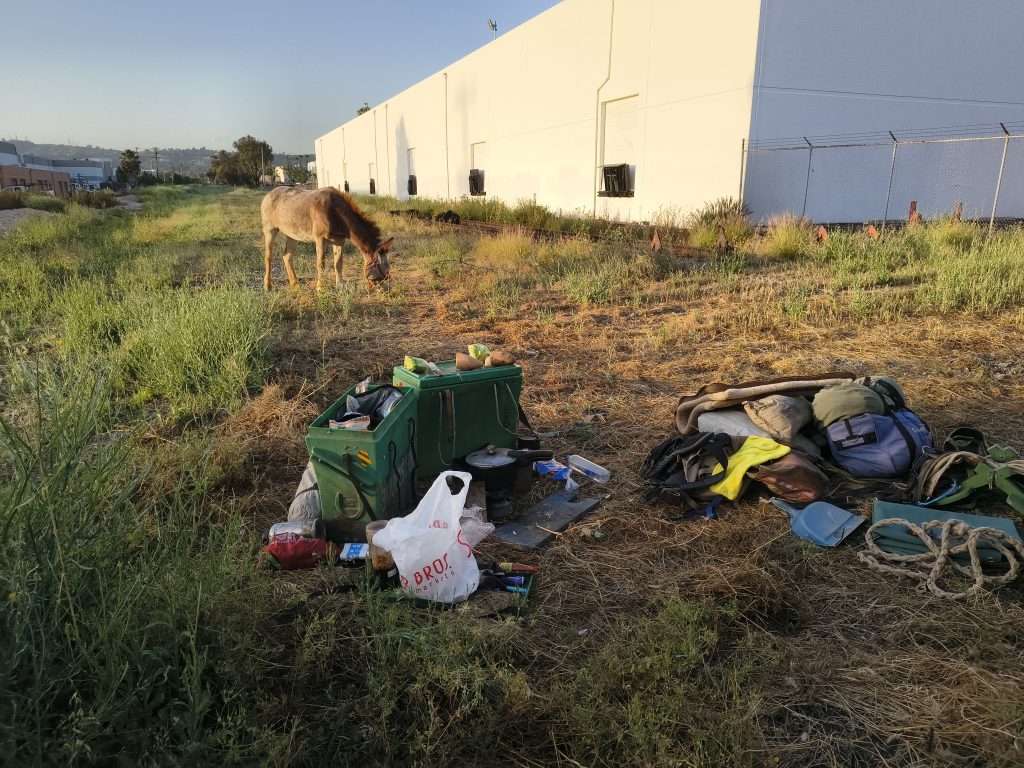
The 3 Mules ProjectJourney isn’t a performance or stunt. Mule lives entirely outdoors, foraging for food, relying on donations of oats and vegetables, and sleeping wherever he can find a quiet place that won’t land him in legal trouble. That’s harder than it sounds. California’s laws often prohibit overnight camping on public land, leading to occasional arrests and citations. He’s even been jailed and briefly committed to a psychiatric facility, as happened during an arrest in Gilroy. His mules were sent to a shelter, and he was locked up for six days before a patients-rights advocate intervened.
Still, Mule remains committed to what he calls the “sacred act of walking,” which he believes is essential not just to individual well-being, but to the health of the planet itself.
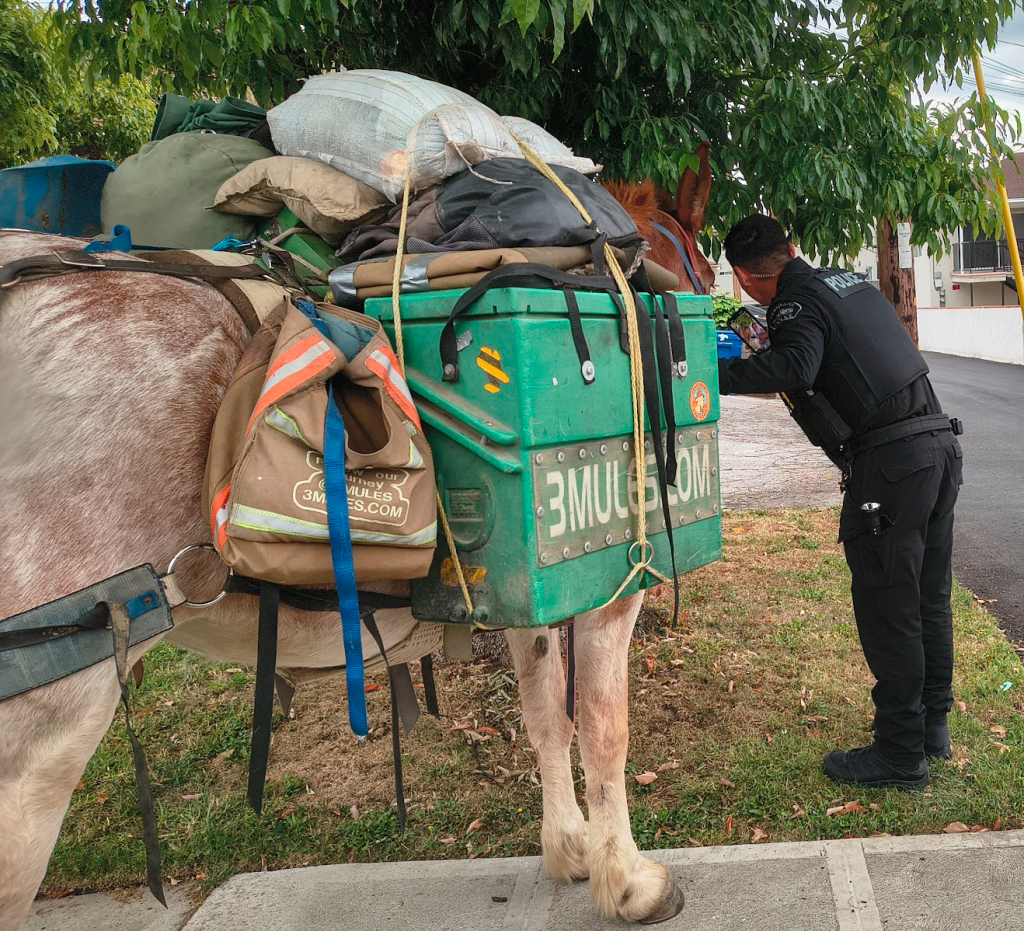
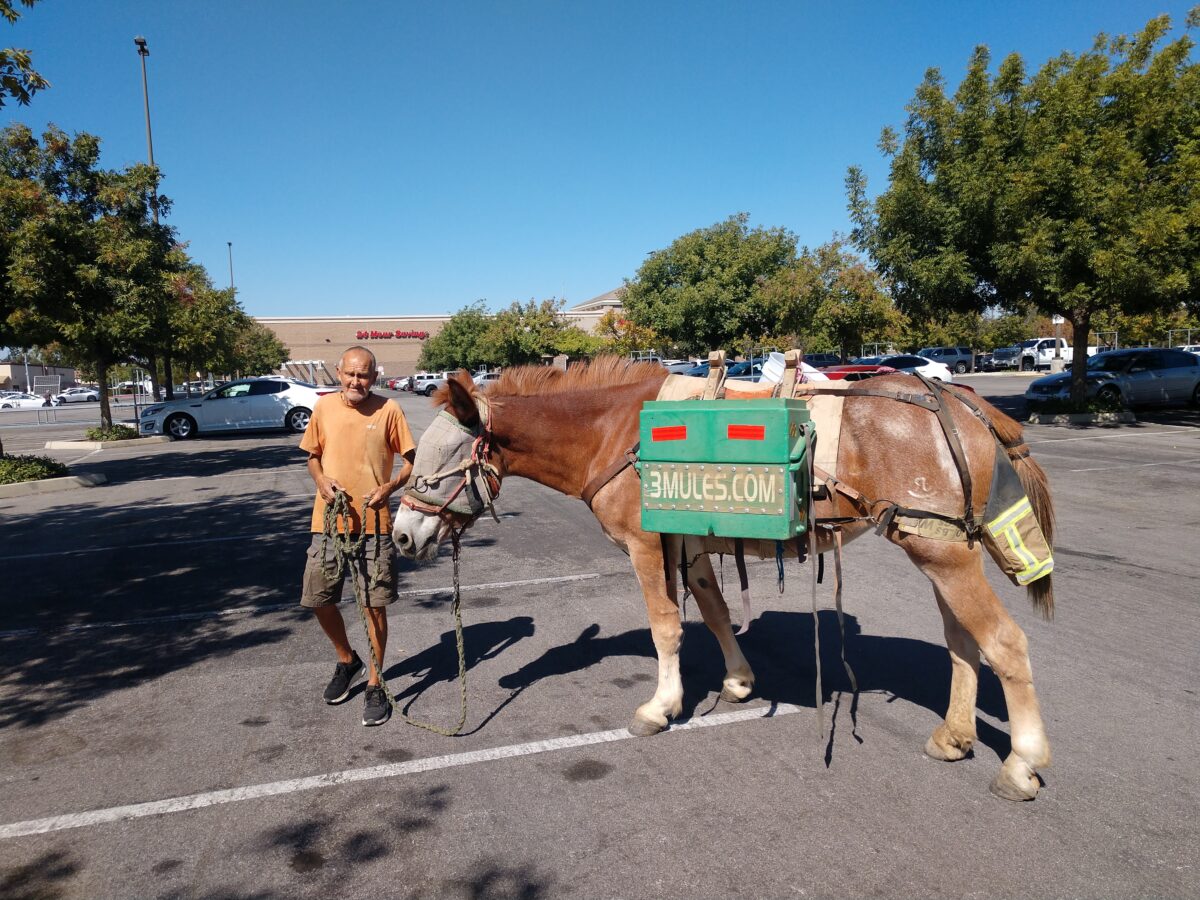
Mule travels with the help of his equine companions, most recently a sorrel molly mule named Rosie. Over the years, other mules – Little Girl, Lady, Little Ethel, and Leroy – have come and gone, retired or passed on, but each has been part of the journey. The mules carry gear and food and graze along roadsides and fields. Mule is careful to stay within animal welfare guidelines, ensuring his mules carry no more than 20% of their body weight and are well-fed, hydrated, and monitored for health issues.
Though many assume he’s homeless, Mule insists that he’s simply “from the outside.” He doesn’t live in houses or drive cars. He exists in and with nature, embracing unpredictability, open space, and a sense of spiritual purpose. His lifestyle has drawn praise and admiration online, with thousands of followers tracking his movements and mission on the 3 Mules Facebook page and website. Some stop to offer food or water, or invite him to rest on private land for a night. Others report him to authorities, concerned about the animals or simply confused by his presence.
He’s walked the boardwalks of Venice Beach, slept under BART stations in Oakland, and traversed vast stretches of wilderness on Bureau of Land Management territory, where he’s witnessed suburban sprawl eat into spaces once left untouched. Two years ago, Mule walked the 295-mile stretch from Las Vegas to Ely, Nevada, only to turn back west when he realized how much land was disappearing.Twelve years ago, Mule was driven to walk out of Nevada, enter California, and bring the nomadic way of life into the heart of the California megatropolis. That moment shifted his focus – from wandering the wilderness alone to speaking up about the loss of public space.
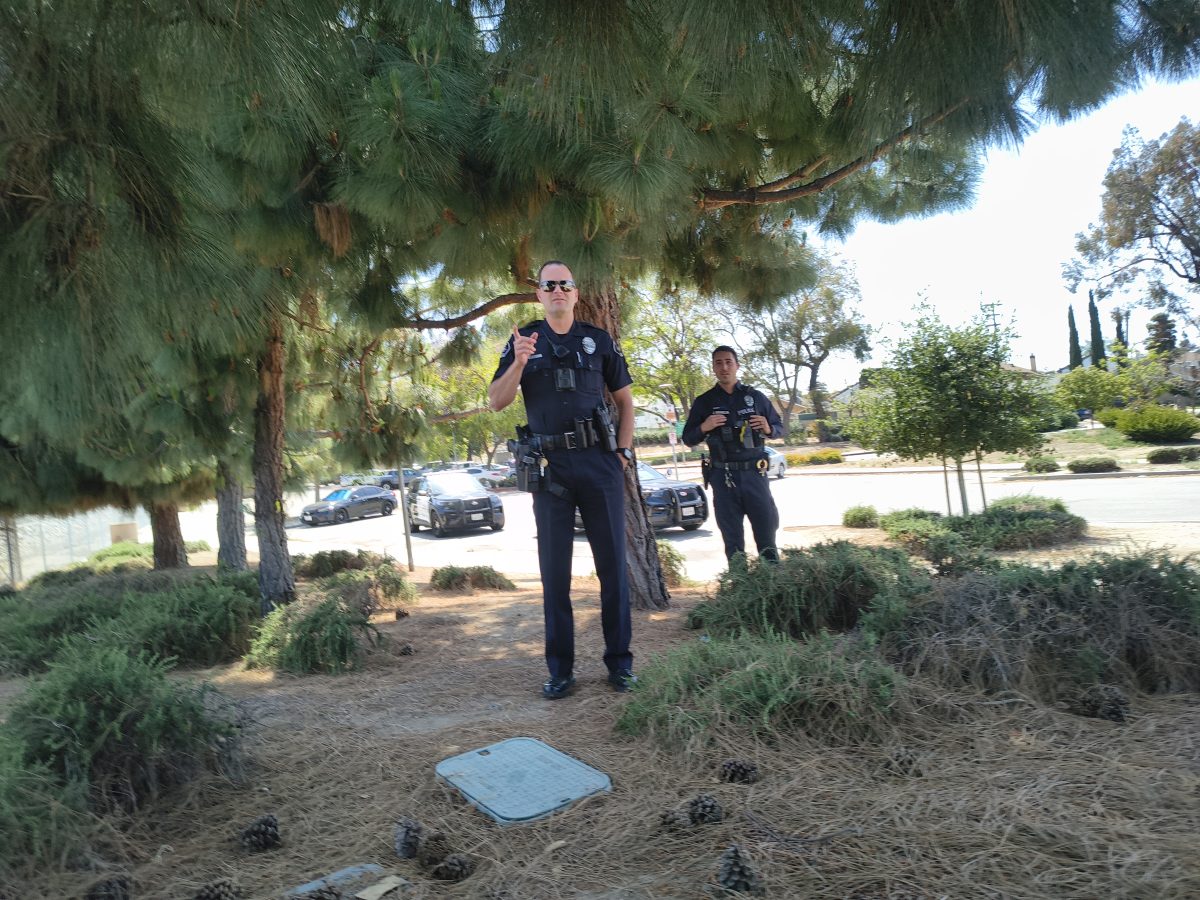
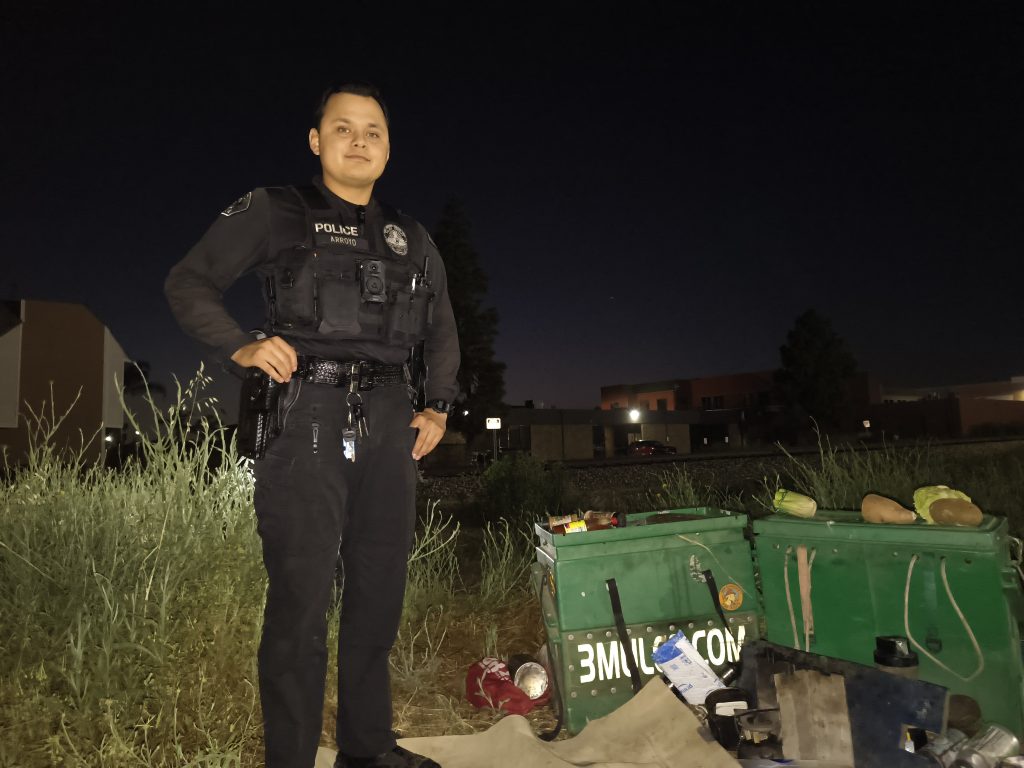
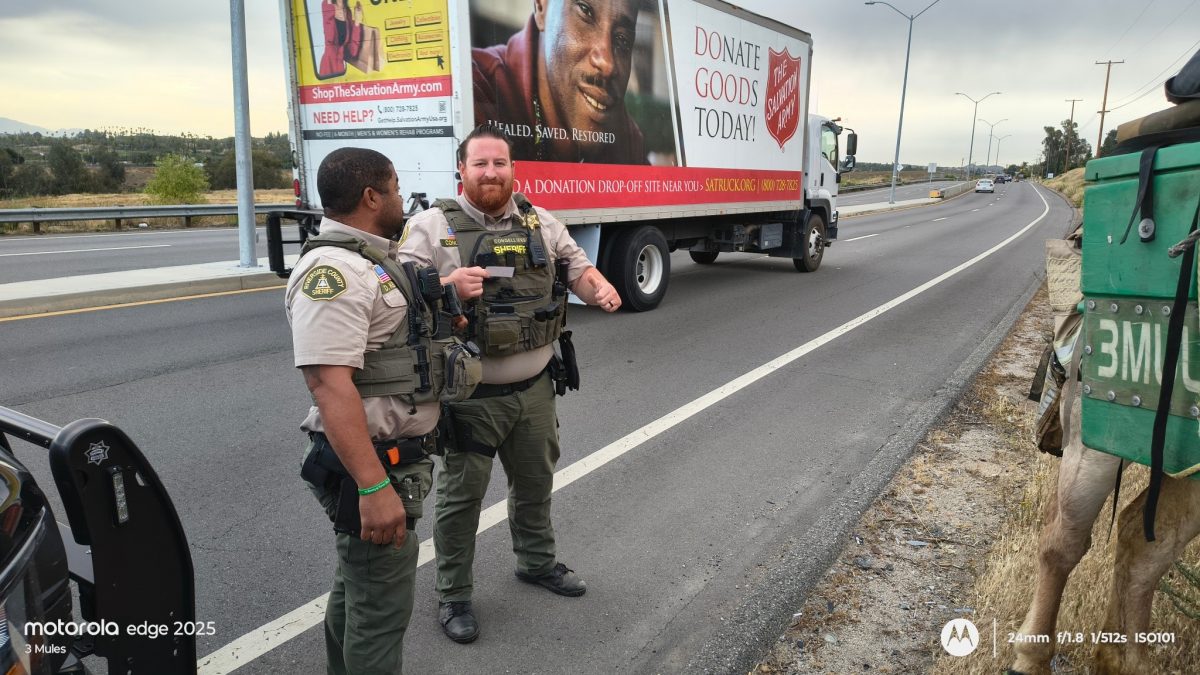
Despite frequent interactions with police, Mule maintains that he stops on public lands only to rest at night for a period of less than 24 hours. He doesn’t set up permanent camp or collect garbage. “We’re not homeless. Our home is the Earth,” he says.
Mule’s attorney, Sharon Sherman, who represented himthe Mules pro bono in 2013 was intrigued by the legal and philosophical implications of his way of life. “There is always a balance between people’s freedoms and the needs of a community,” she said. “Mule really made me stop and think about issues I’ve never considered before.”
For Mule, the right to walk freely is not just personal, it’s universal. “Why do you have more rights in a car than if you are walking?” he asks.
The San Diego appearance is just one stop on a continuous migration that Mule says he’ll continue “as long as he can.” And while his mission is unconventional, its message resonates with timeless urgency: to protect the natural world, to move with intention, and to remember that freedom is not something to be taken for granted – it’s something to be lived, one step at a time.
The California High-Speed Rail Authority in 2008 said the high-speed rail line would cost $33 billion and begin service by 2020. So far, only about 119 miles of the planned 776-mile railroad have commenced construction, and the estimated costs have soared to as much as $128 billion.
An inspector general report in February 2025 found the project was unlikely to meet its 2033 passenger service goal and identified a $6.5 billion funding gap for the Central Valley segment between Merced and Bakersfield.
An extensive bike path trail system for pedestrians, equestrians, cyclists connecting all communities to all communities all over the state could have been built for a mere pittance of what’s been wasted on this ridiculous high speed train.
The non-motorized travelers must be separated from the deadly weaponized automobile. The deadly weaponized automobile is killing non-motorized travelers at an ever-increasing rate each year. The idea that the two can coexist safely sharing the same space is proven year after year to not be possible.
Time to use California money for something worthwhile and valuable. An extensive trail path system for the non-motorized mode of travel.
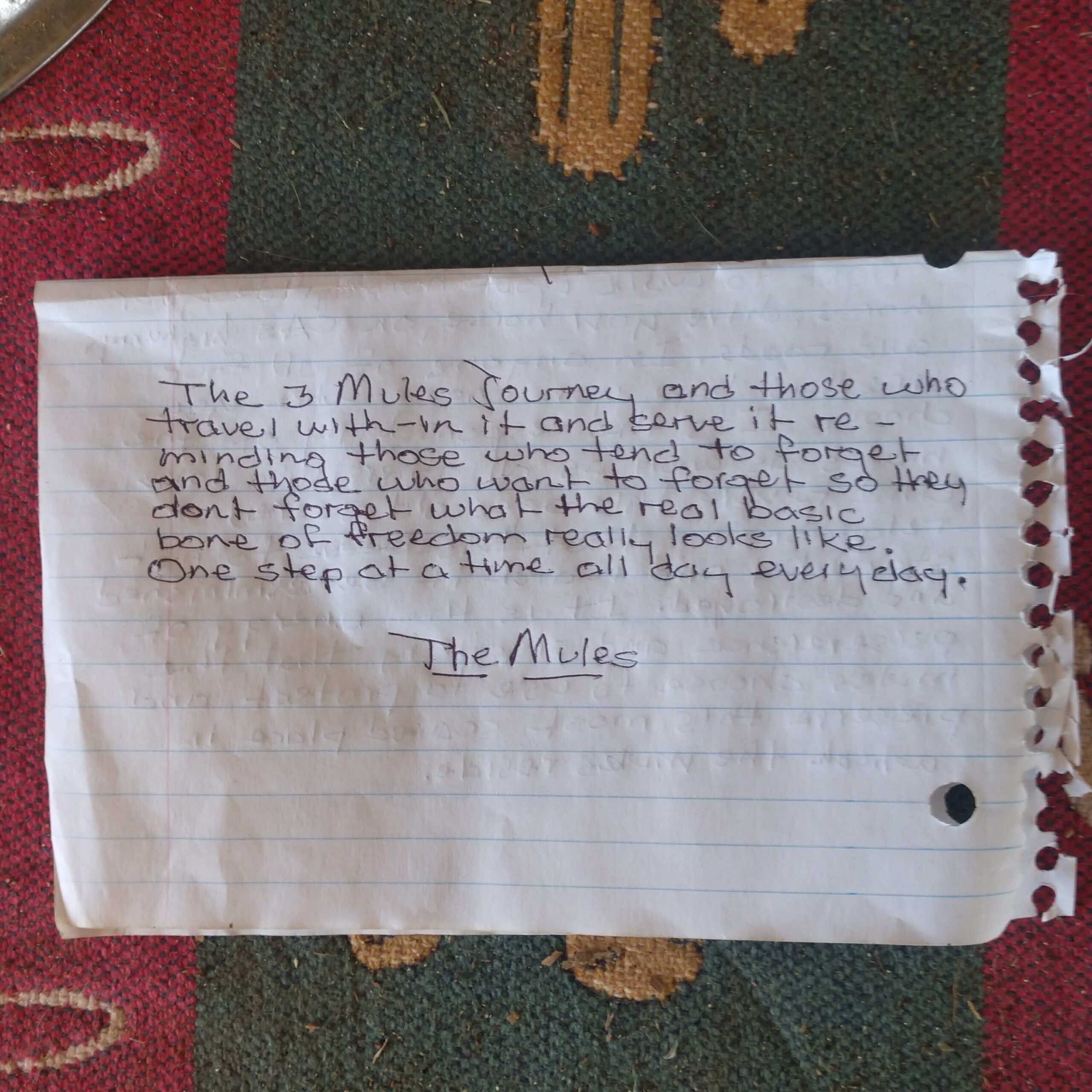
The 3 Mules Journey and those who travel within it and serve it reminding those who tend to forget and those who want to forget so they don’t forget what the real basic bone of freedom really looks like. One step at a time all day every day.
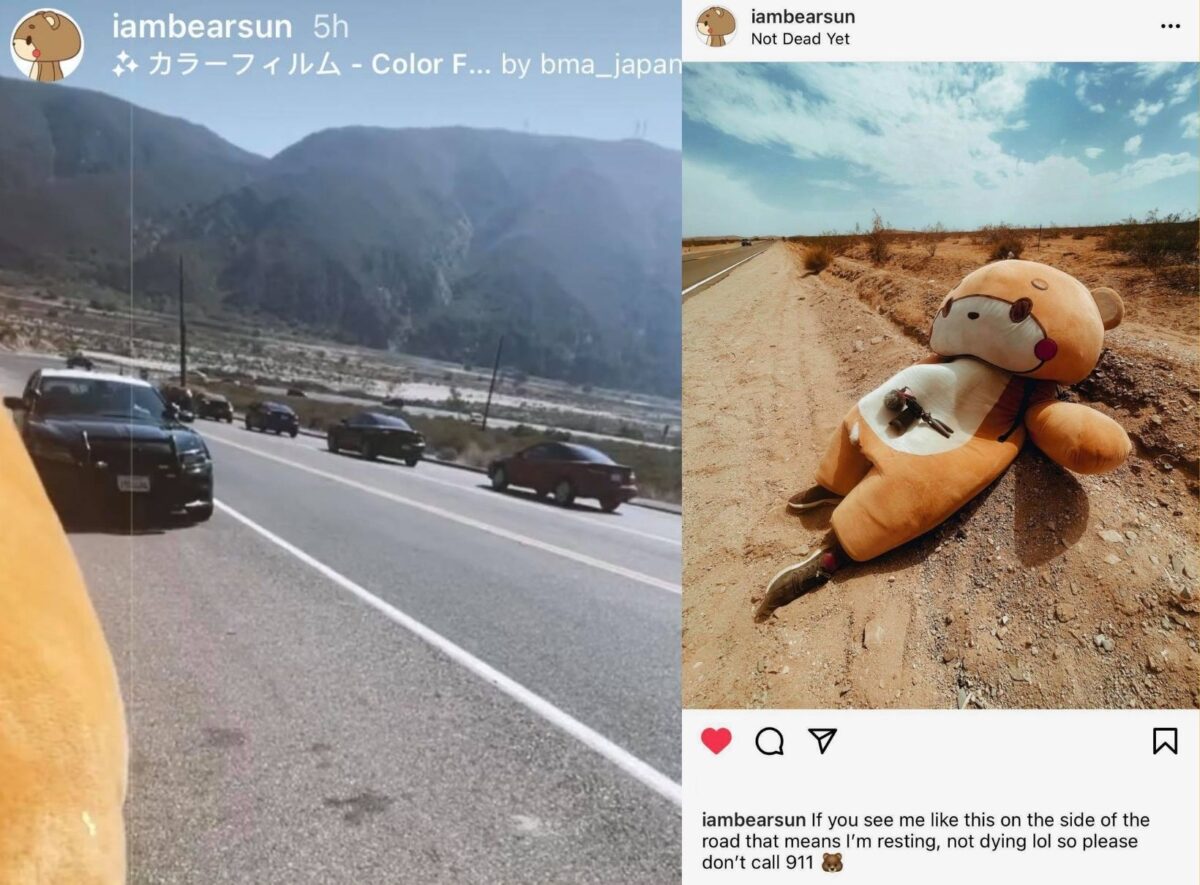
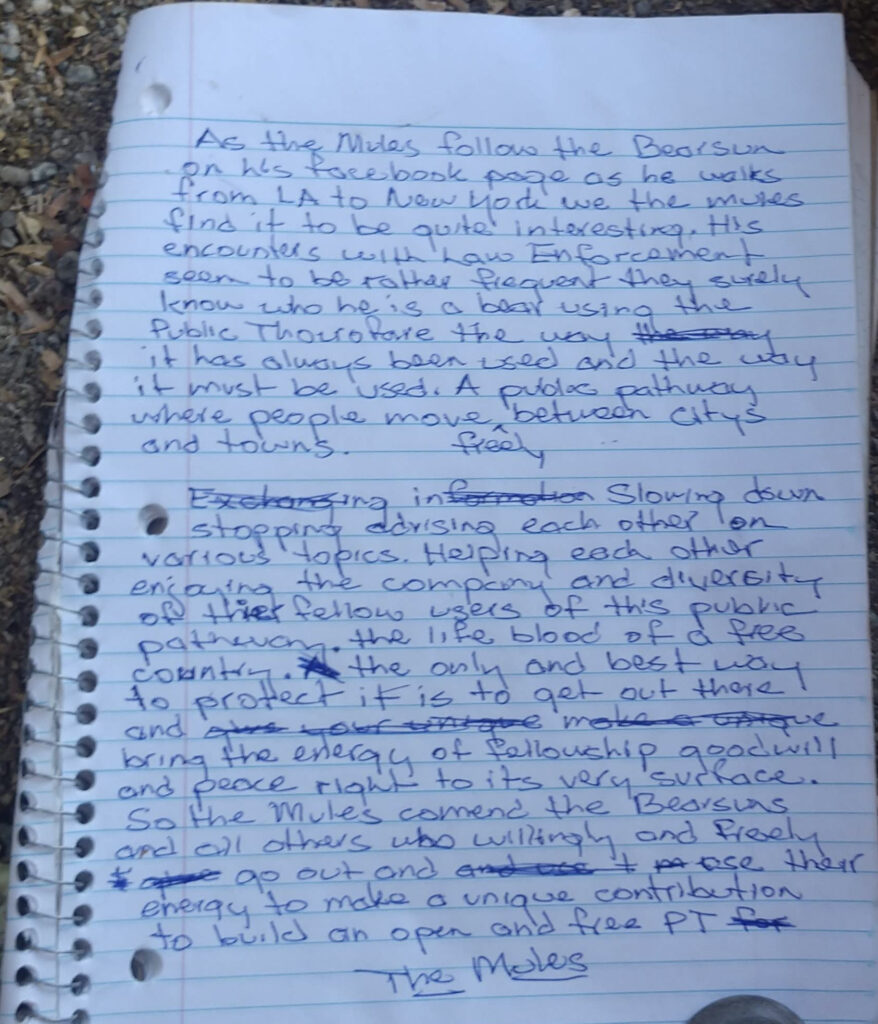
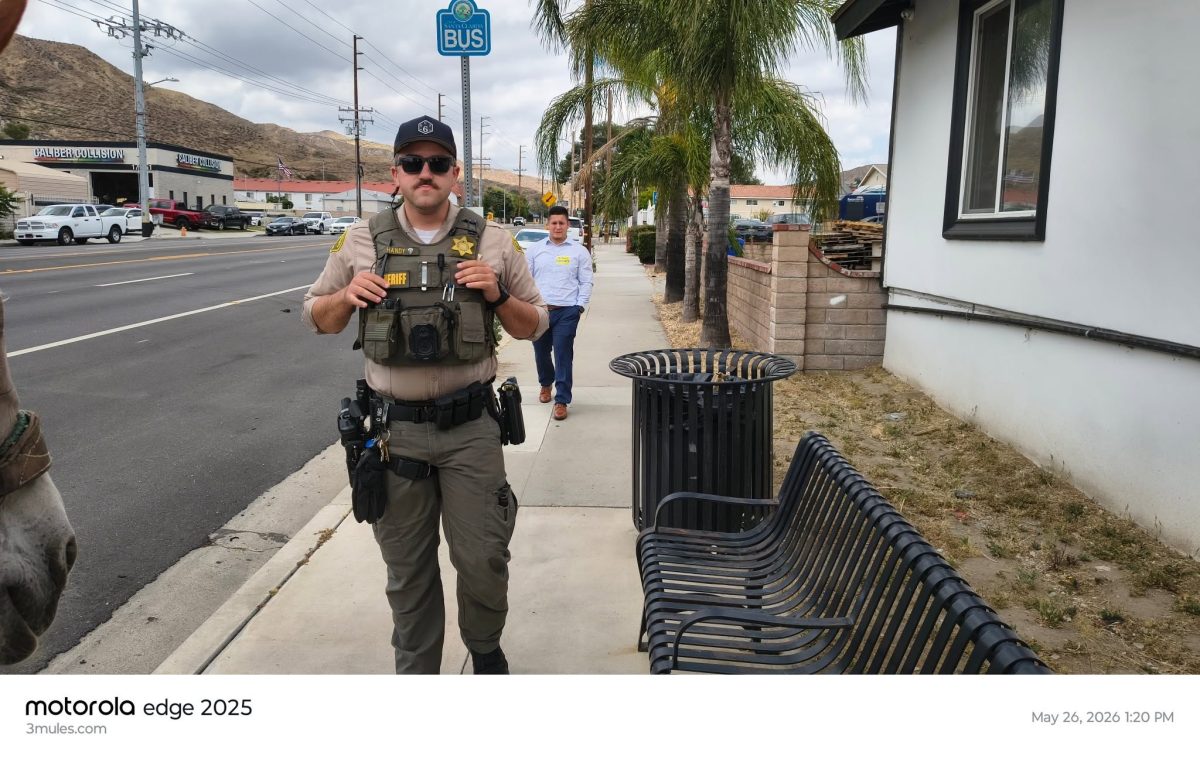
As the Mules follow Bearsun on his social media pages as he walks from Los Angeles to New York City, we the Mules find it to be quite interesting. His encounters with law enforcement seem to be rather frequent. They surely know who he is. A bear using the public thoroughfare the way it has always been used and the way it must be used. A public pathway where people move freely between cities and towns, slowing down, stopping, advising each other on various topics, helping each other, and enjoying the company and diversity of their fellow users of this public pathway. The life blood of a free country. The only and best way to protect it is to get out there and bring the energy of fellowship, goodwill and peace right to its very surface.
So the Mules commend Bearsun and all others whose journeys the Mules have followed, such as Davide Travelli and Chen Guan Ming, who willingly and freely go out and use their energy to make a unique contribution to build an open and free Public Thoroughfare.
3/19/2021 Lawsuit update: California Highway Patrol headquarters in Sacramento and CHP Templeton officer Agredano did not respond to our initial mailing of the complaint and summons within the 20 day required amount of time. Therefore, our lawyer hired two processing services to deliver the summons and complaint. The summons was delivered to CHP Sacramento by Moe’s Processing Service on 3/16/2021 (cost $35), CHP Templeton officer David Agredano on 3/19/21 by United Process Servers (cost $95), and acknowledged by San Luis Obispo Superior Court on 3/19/2021. We are now waiting for the defendants to respond. They have 30 days.
Synopsis As the Mules wander and roam throughout the western half of America, we are showing all those by whom we pass the extreme value of this ages old sacred relationship between human being and horse. The Mules are also showing that all others who travel by their own speed and their own power (foot, bike, horse) must have access to the public thoroughfare unhindered and unobstructed. Non-motorized methods of travel must be protected by all those who depend on these alternative ways of traveling.
On January 23, 2020, the Mules were unlawfully and illegally arrested and incarcerated by the State of California/California Highway Patrol (CHP) using the false pretense of safety to justify the arrest. The Mules have brought this lawsuit against the State of California and its enforcement agency CHP to protect the most sacred right in this country for all its citizens to move freely how they choose, when they choose by using the Public Thoroughfare and all city, county, state roads to do so.
Was the Mules arrest planned and executed on purpose by CHP or simply their gross misunderstanding of the state law? CHP used the two words “safety hazard” to justify our arrest. The Mules are a legal but slower mode of transport. The safety hazard is not the slower legal modes of travel (pedestrian, cyclist, equestrian) but the high speed motorist (HSM) who refuses to obey the law, reduce its speed, stop if necessary, to create a safe space for other slower modes of transport, such as the Mules, where they can pass each other safely.
On January 23, 2020, when the CHP stopped and ordered the Mules to stay off the Nacimiento Lake Road, the area had no alternative routes for us to take. We had no physical way to get out of the location where we were other than continuing to proceed forward. The officer used his radio to contact animal control to pick up the mules for impoundment and the Monk was then taken to jail by CHP.
The Mules will not shirk their responsibility to themselves, their ancestors, and all those who will follow us, having the deep need within their bones to spontaneously move freely on this earth.
Proof of Service, Summons and Complaint delivered to CHP Sacramento
CHP dash cam shot of 3 Mules walking along Naciemento Lake Road prior to their arrest on January 23, 2020.
San Luis Obispo, CA: On January 21, 2021, John Sears, who lives a nomadic lifestyle and has traveled the state of California with his mules for the past eight years, filed a lawsuit in San Luis Obispo Superior Court alleging that the California Highway Patrol wrongfully and illegally arrested him in violation of his natural, Constitutional and statutory rights.
As noted in the first paragraph of the complaint: “By this action John Sears seeks to protect this ages-old nomadic way of life and the sacred relationship between man and horse to travel together with reverence and respect for this beautiful place in which we all reside called Earth.”
Sears, 73, and his mules began traveling when he was 36. He has lived full-time outside and traveled with his mules after retiring from his work as a tree trimmer in 2001 at age 54. He documents their endless journey on his website 3Mules.com, 3 Mules Facebook and Instagram pages, which have over 60,000 followers worldwide.
On January 23, 2020, the Mules were walking along Nacimiento Lake Drive, a rural two-lane country road near Paso Robles in San Luis Obispo County. Such route is the only route between Bradley, California and Paso Robles other than Highway 101, and is part of the Juan Bautista de Anza National Historic Trail, a historically designated trail that stretches 1200 miles from Nogales, Mexico, through the California desert and coastal areas in Southern California and the Central Coast region, to San Francisco.
Despite the Mules right to travel such road, and all public thoroughfares in California, excluding interstate highways, he was ordered by CHP officer David Agredano to “stay off the road.” Such order was not only impossible to safely comply with, it was in violation of Sears’ rights under the U.S. and California Constitution.
Sears states: “Nowhere in the California vehicle code does it state that the public thoroughfare is for the exclusive use of the high speed heavy machine called an automobile.”
The California Vehicle Codes and Food and Agricultural Codes provide all non-motorized travel equal access to the public thoroughfare. (Veh. Code § 21050, See also, Food and Ag Code § 16902, 16903.
“The driver of any vehicle approaching any horse drawn vehicle, any ridden animal, or any livestock shall exercise proper control of his vehicle and shall reduce speed or stop as may appear necessary or as may be signaled or otherwise requested by any person driving, riding or in charge of the animal or livestock in order to avoid frightening and to safeguard the animal or livestock and to insure the safety of any person driving or riding the animal or in charge of the livestock. “
California Vehicle Code 21759
Sears notes: “The Mules were not creating a safety hazard. The Mules were legally using the public thoroughfare in conformity with the state vehicle code. The motorist has one of two options: 1) obey the state vehicle code, slow down, and stop if necessary, when approaching livestock, or 2) disobey the state vehicle code, refuse to slow down, recklessly pass with no concern for the consequences, and call 911 to complain that there is a person walking with horses on the road.”
Along substantial stretches, Nacimiento Lake Drive is hemmed with steep banks on both sides of the road. It has narrow to non-existent shoulders in many areas as the CHP dash cam video clearly shows. The non-paved area directly adjacent to the road was a steep upward bank, which would be difficult to impossible for a pack mule to navigate.
“The Mules were walking as close to the steep bank as we could to provide the motorists that were obeying state vehicle codes to safely pass.”
Sears further notes: “If this arrest was legal, then all U.S. citizens traveling under their own non-motorized power (equestrians, pedestrians, cyclists, wheelchair, and all others) is likewise illegal. This nomadic lifestyle which the Mules practice, which is over hundreds of thousands of years old, is how the Mules live on this earth. The Mules are bringing this case to court to preserve the right for all equestrians, pedestrians, and cyclists to travel on these public thoroughfares without fear of arrest.”
Sears filed a complaint alleging violation of his civil rights under Federal and California law, false arrest, and declaratory and injunctive relief. In addition, to his damages, he seeks a declaration of his rights that he can present to law enforcement in the future, and for the CHP to issue a training bulletin informing officers of the right for equines and other animals to use the public thoroughfare.
Mules-vs-CHP-p1
Image 1 of 15
People often ask the Mules what their mission is. “Our purpose is to walk and live peacefully taking only what we need. Seeking balance and harmony with all that surrounds us and bringing the energy and value of this ages old way of life to all of those who we pass.”
“Spiritually, we are all unique. The Mules are experiencing the sacredness of this place in our own unique way. We are not doing anything spectacular. We get up in the morning, fix something to eat, and walk all day long. We enjoy it. Just walking. We enjoy the sacred act of walking in harmony and balance with the energy of this beautiful Earth that flows in, around and through us.”
“The public thoroughfare has been designed for the high speed motorists and their automobiles,” Sears explained. “The Mules and those who travel under their own power and speed (equestrians, cyclists, hikers) must preserve the right to use these same public thoroughfares as there is no adequate trail system to get equestrians and non-motorized travelers from one community to the next in this state.”
Sears has hand delivered copies of his Declaration of Emergency to over 200 city halls in California as well as to the governor’s office at the California State Capitol. In the declaration, he says the Natural World is being destroyed by a sprawling Megatropolis. Sears describes the Megatropolis as “the man-made world, spreading sprawling concrete, putting up lanes, putting up buildings everywhere. It wants all the remaining open space and it is unrelenting. It doesn’t want any other venues (pedestrians, cyclists, equestrians) to use the public thoroughfare except for its most favorite tool, the automobile.”
For further press inquiries or interviews, contact Attorney Todd T. Cardiff Office (619) 546-5123 or Cell (619) 885-1443 – www.tcardifflaw.com
Wednesday, January 22, 2020, after walking 15.3 miles from Pleyto and past Lake Nacimiento, we stopped here along G14 to spend the night. We have walked this scenic back road route repeatedly in past years.
On Thursday morning, I awoke, fixed breakfast and packed up the mules. We got back onto G14 heading towards Paso Robles and walked approximately three hours when a California Highway Patrol (CHP) cruiser pulled up along side us. He said he had been getting calls that we were walking on the road. He asked me to do him a favor and not walk on the road. My reply was that the Mules have the right to walk on the road. We are not breaking any laws and we will continue to do so for the simple reason that we have the right to. There was no alternative side road or trail along G14 to walk to Paso Robles. At that point he left.
Road G14
We continued walking 10-15 minutes when the CHP officer returned with another CHP officer in another cruiser. He stopped in front of us, got out of his cruiser and told us that we could not walk on the road. We reasserted our right to walk on the road.
It was obvious if you looked at the road there was no where else to walk. we were walking as far to the edge as possible. Little Girl who I was leading was walking right abreast of me and Little Ethel was abreast of Little Girl. Little Ethel was the one furthest in the road. There was plenty of room for a passing motorist, slowing his or her automobile (which is required by California law when approaching other legal users – cyclists, equestrians, pedestrians – of the public thoroughfare) to an appropriate speed to safely pass. Motorists on G14 were doing so, slowing down and passing safely with no problem.
G14
The officer continued to assert that we could not walk on the road. We continued to assert we had the right to walk on the road and that we could not sprout wings to go anywhere else as we were landlocked and there was no alternative way to walk out of where we were standing. We went back and forth like that for a good period of time. Officer trying to convince us that we had no right to walk on the road which was ludicrous.
The California Driver’s Handbook clearly states that equestrians have the right to use the public thoroughfare.
Animal-Drawn Vehicles
Horse-drawn vehicles and riders of horses or other animals are entitled to share the road with motor vehicles. It is a traffic offense to scare horses or stampede livestock. Slow down or stop, if necessary, or when requested to do so by the riders or herders.
Side note: On August 31, 2013 in Morgan Hill California we had a similar encounter where the Mules were stopped by California Highway Patrol and told to get off the road or be arrested. (Details here.) We had no place to get off the road where we were without walking on the road (because we don’t have wings). We were arrested and mules impounded for “Code 2800(a) VC – Disobey Peace Officer – Lawful Order“.
Santa Clara Superior Court Judge Jerome Nadler dismissed the case based on the arrest being invalid. Citation was for “disobeying the lawful order of a peace officer” when the Mules refused to leave the highway. Judge Nadler determined that the Mules had a legal right to be on the highway and therefore was not disobeying an officer since the Mules were abiding by the law. Below is video taken by documentary film maker John McDonald interviewing Judge Nadler about our case.
“I’m Jerry Nadler, I’m a superior court judge for Santa Clara County. On September 5, 2013 I was handling what’s called the arraignment calendar in the South County Courthouse of Santa Clara County in Morgan Hill and he was on my arraignment court calendar and in custody. He was charged with a vehicle code violation of failing to follow the orders of a peace officer.
Well here’s a guy that is simply proceeding down the side of the road lawfully with his mules and people are simply distracted because they haven’t seen mules in a long time. Unfortunately the system doesn’t work really well with really unique individuals or types of cases. And perhaps Mr. Sears is that sort of unique case where he’s charged with an offense that it appears that he had better insights about than the officer.
You know the officer is really concerned about protecting the highway, especially on a holiday weekend. But the officer still has to be aware of what the law is with regard to it as well. And again in this case it is sort of a unique case. I’m sure it’s the first mule case the officer has ever run into. But again, the officer is obligated to know what the law is. And, if the law allows for a pedestrian and his animals to be on the highway, then he’s got to perhaps make some other decisions. But I can certainly understand why the officer acted the way he did.”
Jerry Nadler, Superior Court Judge for Santa Clara County
We bantered back and forth for a good period of time when the officer finally said if I come back again you will be arrested and your animals will be impounded. He then left with his fellow officer.
Little Girl and Little Ethel along G14.
Well now what were we to do? There was no side roads to take off on. There was nothing but G14. There was no cell phone service for us to call or post for trailer assistance. The officer offered no alternative means for which we could safely proceed to our destination of Paso Robles. We had no choice but to stand there on the side of the road for hell to freeze over or to continue to walk to Paso Robles on G14. So we had to do just that, because again, the mules and myself do not have wings.
After walking 10 minutes further down the road, the officer was stationed with his partner on a side road to our left. I do not know the name of this side road or if it was an alternative road to get to Paso Robles. The officer got out of his cruiser, approached me, stepped in front of me and said I was under arrest. He then took the lead rope from my hand and handed the lead rope to the other officer who took Little Girl and Little Ethel to the other side of the road and told me I was under arrest. He asked me to put my hand behind my back, which I did. Then he hand cuffed me, took me to his cruiser, opened the door, and asked me to get inside, which I did. I offered absolutely no resistance.
We have now been charged with obstruction. We were not charged for walking on the highway because we had every right to be walking on the highway. We have been charged with obstruction resisting arrest. I did not resist arrest. Little Girl and Little Ethel were taken to San Luis Obispo Animal Services, while I was taken to San Luis Obispo County Jail where I was booked around 3pm and charged with resisting arrest under California Penal Code Section 148(a) PC, a broadly defined criminal offense that makes it illegal to intentionally resist, delay or obstruct a law enforcement officer.
Note the irony of California Highway Patrol website with horses on the cover and statement: “The mission of the California Highway Patrol is to provide the highest level of Safety, Service and Security.”
If the CHP officer was able to contact animal services to bring a trailer to transport the mules and myself to San Luis Obispo 40 miles away, why couldn’t they make a decision to “provide the highest level of Safety, Service, and Security” and escort or order trailer to transport the Mules to Paso Robles our destination at the end of G14 about 5-10 miles away?
Side note: On New Year’s Day January 1, 2020, we had a similar encounter with San Benito County CHP (documented here) under much the same circumstance. However, San Benito County CHP gave up on telling us we couldn’t walk on the highway as they knew that we had the right to walk on that road as documented in the San Benito County General Transportation Plan. Instead, the officer relented on his assertion that we could not walk on the highway and offered us a solution that we could continue to walk along the shoulder of the road (which we were already doing) and they would escort us from behind to our destination San Juan Bautista. But at that moment, a local resident who followed our 3 Mules Facebook page stopped and told us that we had an alternative back road to walk to San Juan Bautista, which we took and no longer required a CHP escort. CHP did not tell us about this alternative route 100 yards away.
During booking, they took away my sandals that I was wearing so I was barefoot on the cold floor in jail wearing only a t-shirt and thin pants. Jails like to keep the temperature inside very cold. Don’t understand why my shoes were taken away. Did not have to share a cell with anybody. I paced from the time I entered the cell well into the next morning. Must have walked about 20 miles building the spiritual energy I knew that would be harbored and used to deal with our ongoing challenges of our upcoming court case and our use of the public thoroughfare.
I was released from jail without paying any bail with a court date to appear March 23, 2020 at 8AM in San Luis Obispo Superior Courthouse Annex Room 220, 1050 Monterey St, San Luis Obispo, CA 93408 .
After I was released from San Luis Obispo County Jail, I walked over to Animal Services next door where Little Girl and Little Ethel were housed. The cost for release is $266. We posted a GoFundMe to help pay for the cost for release and within minutes of posting reached the limit quicker than we could turn off the fundraiser to stop raising funds. A total of $500 was raised. The Mules are humbled by the response from those who donated quickly and generously to our request. Thank you very much. A detailed accounting with receipts on how this money was spent will be posted on this website.
Paid $266 receipt of release of Little Girl and Little Ethel from SLO Animal Services.
While at the animal shelter, we had another dilemma. The mules were in San Luis Obispo, but our gear and belongings were at the CHP office in Templeton, 31-miles away. So we posted on our 3 Mules Facebook page asking if anybody could transport the three of us from San Luis Obispo to Templeton before CHP closed for the day.
The Nation, the Three Mules Nation, shared our request for trailer assistance. As well, Animal Control Supervisor Patrick was reaching out to his contacts to help find a trailer ride to reunite us with our belongings. He was able to find a group that could help but they couldn’t arrive until after 4pm, which risked us not getting to the CHP office 31 miles away before its closing for the weekend. The Mules want to recognize San Luis Obispo County Animal Shelter Supervisor Patrick and his staff for taking care of Little Girl and Little Ethel and trying to help us find a trailer ride to our belongings.
Patrick and his caring staff at San Luis Obispo County Animal Shelter with the Mules
We received a private message from Jennifer who said she could assist and bring us to Templeton, which she did. While waiting for trailer ride, we met Jim who stopped by the animal shelter to offer his assistance as well. He lives near the CHP office and offered us to rest the night on his property so we could re-gather ourselves which we accepted.
Thank you Jim for your hospitality.
Jennifer arrived at San Luis Obispo animal shelter with her trailer and drove us to CHP office in Templeton so that we cold pick up our pack boxes and other belongings.
Thank you Jennifer for transporting us to Templeton. Little Girl and Little Ethel at CHP Templeton office packed up and ready to go
We arrived at CHP Templeton in the afternoon to pick up our belongs. While there we had a conversation with CHP Lieutenant Coomer, who provided us a map outline every CHP Area boundary in the state and a document listing the contact telephone number for every CHP Communication Center and Area Office in the state. He said it might help if we the Mules called these area offices ahead of time and let them know we will be traveling through their area so that when the dispatchers get calls from the public, the dispatchers will know to be expecting it.
CHP Geographical Organization map given to us.
While we appreciate Lt. Coomer providing us this information, we live in the United States of America. “Life, Liberty and the pursuit of Happiness” is a well-know phrase in the United States Declaration of Independence. The phrase gives three examples of “unalienable rights” which the Declaration says have been given to all humans by their creator, and which governments are created to protect. Freedom of movement (travel) was also thought to be a fundamental right of all U.S. citizens during the drafting of the U.S. Constitution as not needing explicit enumeration. Lt. Coomer’s suggestion for us or any U.S. citizen to call law enforcement in every place we walk in California is requiring U.S. citizens to ask for permission to travel within California, which is against our unalienable rights and against state law.
If a concerned citizen calls dispatch and an officer comes out to investigate, the officer should know the California codes that we are allowed to walk where we are. The officer should communicate with dispatch and other law enforcement in the area of the situation, whether it be equestrian travelers, pedestrians, cyclists or people in wheel chairs.
In the California Driver Handbook, cyclists and equestrians have the right to take the lane if there is not sufficient shoulder on a road to ride or walk. Motorists must slow down or stop until they can safely pass leaving 3 feet for safety or until the cyclists, equestrian, or pedestrian has sufficient shoulder room to move aside.
The Mules were not breaking any laws walking on G14 as we were not cited for obstructing traffic because we were not. Traffic was simply required by law to slow and pass at a safe speed. We were cited for resisting arrest for disobeying a lawful order which was obviously not a lawful order. The officer wanted us to get off the road when we had no physical way to get out of the location where we were at (because we don’t have wings) without walking out of the location. We did not have phone service in the area to make any phone calls or post to the Nation, the Three Mules Nation, for trailer assistance. Again, the officer did not provide us any solutions or alternatives on how we would continue our journey without use of the public thoroughfare.
When we arrived at CHP Templeton office, Marcia and her daughter Tisha were there waiting for our arrival. Marcia has been a supporter and follower on 3 Mules Facebook page since June 16, 2014. We always enjoy when we get to connect a name we see regularly on our page via comments to a live person.
Marcia, Three Mules Nation support since 2014Tisha with Little Ethel
The Mules will continue to post more about this case as it evolves and progresses up to our March 23, 2020 arraignment in San Luis Obispo. Our next step is to obtain a copy of the CHP police report. The Mules feel that we were wrongly arrested because we had the right to walk on public thoroughfare G14. We feel that this citation and case should be dismissed immediately and that we should be reimbursed $266 of the mules impoundment fee.
The Mules are seeking a pro-bono attorney willing to represent us. Court Date scheduled for 3/23/2020 at 8 AM in San Luis Obispo Court Annex Room 220, 1050 Monterey Street, San Luis Obispo, CA. If interested, please message us with your contact information.
We are as safe as anybody could be under those circumstances. It’s not our fault that the state of California is allowing these automobiles to move at these horrendous speeds. These speeds are killing people, maiming people, it goes on all day every day. The insurance rates are outrageous and very well understand the chances are that when you get into these automobiles with your children, your families, you’re going to turn into a bucket of blood. It happens every day, all day. These automobiles are not safe.
The Mules move at 2-3 miles per hour. We’re not going to hurt anybody. We never have. We don’t deal out death and destruction as we go along. The automobile does. We are not going to give up our right to move freely in this country.
These public thoroughfares are all that is left. There is no other mechanism to express your right to freedom to move that body of yours from one place to the next when you choose how you choose. When that’s gone, that’s the bone of freedom you don’t have any freedom.
We are not going to give it up. Our way of life depends on moving, living with our surroundings, the trees, the grass, the brush, the insects, the animals, with a meaningful relationship, reacting to these forces all day long with our feet on the ground surrounded by that energy. We have to have the right to do that using the public thoroughfare.
We’re not going to give up that right. When the Megatropolis tries to disguise its real purpose using safety as the mechanism, it’s real purpose is to remove all other venues other than the automobile from the public right of way. It’s to get rid of us, there is no question about it.
March 23, 2020 is a long time away to wait in San Luis Obispo for our arraignment.
Six years ago, on May 29, 2014, the Mules were cited in San Luis Obispo for sleeping outside, which we have slept outside for over half our life. Sleeping is another human necessity to eating and breathing. No life can stay awake and keep moving 24/7/365. Our citation for that case was dismissed on January 15, 2015. Read more about that San Luis Obispo case here.
At the time, a San Luis Obispo newspaper published an editorial that the Mules were a public nuisance, which we strongly disagree. We are one human being traveling with his or her animal companions living a nomadic life outside all day every day as our ancestors have done for hundreds of thousands of years with respect and reverence for this place we call home – Earth.
The Mules were walking east on the shoulder of Chittenden Road (CA-129) in San Benito County towards San Juan Bautista. Suddenly a California Highway Patrol (CHP) cruiser appeared and stopped in front of us. A CHP officer exited his cruiser and requested we stop, freeze in place. We did not do that. Instead, we turned around and walked about 20 yards to a much safer place than the shoulder of the highway.
The officer followed us and upon reaching us asked where we were going. We replied, “Where we choose to go and we have the constitutional right in these United States to do just that using all city, county and state roads, which make up the public thoroughfare to travel and move freely in this country. The officer replied, “You’re on a highway and you do not have the right to be on the highway.”
The Mules knew of course the officer at best was mistaken and knew nothing of the vehicle code he was suppose to be enforcing at worst case was lying (Supreme Court and Federal Court decisions allow police to lie without any fear of accountability) and they do a lot.
“State Route 129 in San Benito County is classified as a Rural Minor Arterial* and is not included in the California Freeway and Expressway System. It is included in the Interregional Road System from Highway 1 to US 101, but is not designated as a High Emphasis or Focus Route. SR 129 is not part of the Scenic Highway System or the National Highway system.”
*Arterials. These facilities make up the principal network for through‐traffic within a community and often between communities. Arterials have between two and six traffic lanes and provide connections between residential areas, shopping areas, places of employment, recreational areas, and other places of assembly.
San Benito County’s General Plan Chapter 6 Transportation and Circulation page 6-9
So the situation remained in limbo with the Mules asserting their right to use the public thoroughfare Highway 129 and the CHP continuing to lie and tell us we were breaking the law by being on the highway. And if we got on it again we the Mules would be arrested and taken to jail.
Then the supervising officer told the Mules, “We don’t want to take you to jail, you’re not going to jail. Let’s find a way to solve the problem.” The Mules replied in no way are we going to negotiate our right to the public thoroughfare away. The supervising officer replied, “We are not asking you to do that. You can walk on the shoulder but not in the lane of traffic.” The Mules replied that’s exactly what we were doing when we were stopped by the officer. The supervising officer then said, “We will give you a CHP escort on 129 to San Juan Bautista.”
At that point, a lady appeared and introduced herself and said she has followed the 3 Mules page for many years. She then said we should take School Road over the hill to Anzar Road, which would take us into San Juan Bautista, which was no more than 100 yards from where we were. The Mules said good.
The CHP escorted us the 100 yards to School Road and left. We have not seen them since.
The Mules
Photos of other people we met also walking along the road on New Year’s Day as we headed toward San Juan Bautista. It’s always good to see other people walking too.
Last Spring, when the Mules were making their way through Palm Springs, a comment was made on one of our posts that the Mules were making bad choices. “Bad choices” is social worker speak for alcoholism, drug addiction, etc.
In none of these activities or addictions do the Mules engage. Instead, we practice the sacred act of walking and the spiritual engagement with creation the Natural World. This is not a bad choice. It is a wonderful choice. A choice created and made available to all from a Trump down to a weak little man and everybody somewhere in between.
The Mules read a Sierra Sun article titled “For body and mind: Neuroscientists ties brain health to outdoors life.” The article was about a neuroscientist’s research that being (living outside) was healthy for the brain. Well, duh!!!! The Mules have known that since the time of birth. That knowledge is imbedded in our bones.
This is why it is so important that the right to travel on and across this country using a multi-use public thoroughfare, open to all its citizens, be protected by all with extreme vigilance.
The Mules
Excerpts from Sierra Sun article:
Outdoor activity is often associated with physical well-being.
Being in the natural world also plays a vital role in mental health, according to Dr. Michael Merzenich, professor emeritus at the University of California, San Francisco and a leading pioneer in brain plasticity research for nearly five decades.
When people are engaged in activities like hiking, Merzenich says, the brain is getting its own exercise, constantly assessing and reassessing the environment for everything from threats to making minute adjustments along an uneven hiking trail.
In the natural world, Merzenich said novel things and surprises trigger this super-charged state, but as people have built cities and more recently, turned their attention to digital devices, they are no longer getting the benefits of being engaged with their environment.
“Our brain is deprived a massive level of exercise by living in an artificial world. We’ve adjusted our local environment so that everything is predictable, we don’t have to think about anything,” said Merzenich.
“Common city life, you only see things in front of your nose and you no longer see things out in the world … you became very, very inadequate at detecting anything that’s surprising or novel. That’s really what we’re designed to do. That’s what our brains are designed to do, we’re designed to be masters of our physical environment, to be looking for the surprises in it that don’t fit, to be evaluating what they mean and what their value is to us. The natural world is just about the best possible way to find all of those surprises.”
With the emergence of mobile devices, Merzenich said the effects are worsening, especially for children.
“There’s no question that the brain of the average little kid right now is vastly different from the brain of a kid even 20 years ago, because the brain basically is plastic, and it changes itself as a function of how it’s engaged,” said Merzenich. “What the child is engaging in is a lot of rule-based behavior, working in activities that are largely rule-based. The kid is doing things that they enjoy and are not valueless, but they’re not the real world, and increasingly we take a sort of artificial approach to life. We don’t problem solve so much as we look up answers to things. We’re changing the way our brains are exercised and that’s changing us.” By being deprived of the unpredictability and novelty of natural settings, according to Merzenich, people begin to suffer from disorders such as depression and anxiety.
“Human survival was dependent on being an accurate, fast interpreter of the meanings of things,” he said. “Another way of putting that is, that it’s an important form of exercise. If I degrade that machinery, I go into clinical depression. If I enliven that machinery, I have a life that’s vital and bright. There’s real value in exercising the brain.”
In order to employ this mental form of exercise, Merzenich’s advice is simply to get outside and be engaged in one’s surroundings, whether it is at a park, on a hiking path or at the beach.
“I tell people try to be a little bit more like a child again,” he said.
“There’s nothing quite so wonderful as being out on a forest path or being some place where everywhere you look there’s something really interesting — if you’re just open to it.”
Last night, the Mules spent the night in Norco in Riverside County, California, also know as HorseTown U.S.A. We found a vacant field where we spent the night. Upon awakening in the morning, I took Little Girl across the street and got her some water and then grazed her along the horse path for about an hour.
I returned to the place we spent the night and fixed breakfast. After enjoying breakfast and watching Little Girl take a nap, we packed up and proceeded on our way north though Norco.
Little Girl taking a nap
We met a number of followers of our Facebook and website pages and enjoyed the conversations. After a mile or so, we saw Norco’s sign HorseTown USA. According to city ordinances, the architecture of Norco “shall reflect a desired Western theme,” including qualities “described as rural, informal, traditional, rustic, low-profile and equestrian oriented.
As a horse community, there are few sidewalks in the city of Norco, instead there are horse trails and riders can ride to town and tie their horses at the many hitching rails and corrals placed close to businesses.
We thank the town of Norco for the pleasant experience as short as it was. It was nice not to be bothered by police officers telling us they were getting calls about a starving horse, a loose horse, a horse dying from lack of water, or a drunken homeless man leading a horse down the road, etc. etc. or expressing general concern as to the sight of the Mules. This did not happen. It was a pleasant experience in Norco, HorseTown USA.
Now we are well out of Norco. It is now time to stop on the public thoroughfare for we have been walking most of the day as any equestrian traveler does and we will claim our right to stop here, fix our dinner, go to sleep on the public domain/thoroughfare as any citizen of the United States has a constitutional right to do so.
Pictured is a sign that says, Emergency Stopping Only. That is an illegal post. No city or county or state has the legal right to post any sign that will prevent any legal user of said thoroughfare to use it in a responsible way. This sign is absolutely attempting to do that. It’s entirely illegal under the constitution of the United States. The public thoroughfare within the United States belongs to the public.
The Mules are a member of that public and we can without doubt unequivocally prove our safe and responsible use of it. We will not accept any form of exclusion from it.