3 Mules Letter to the Mayor of San Jose and the Mayor’s Office response

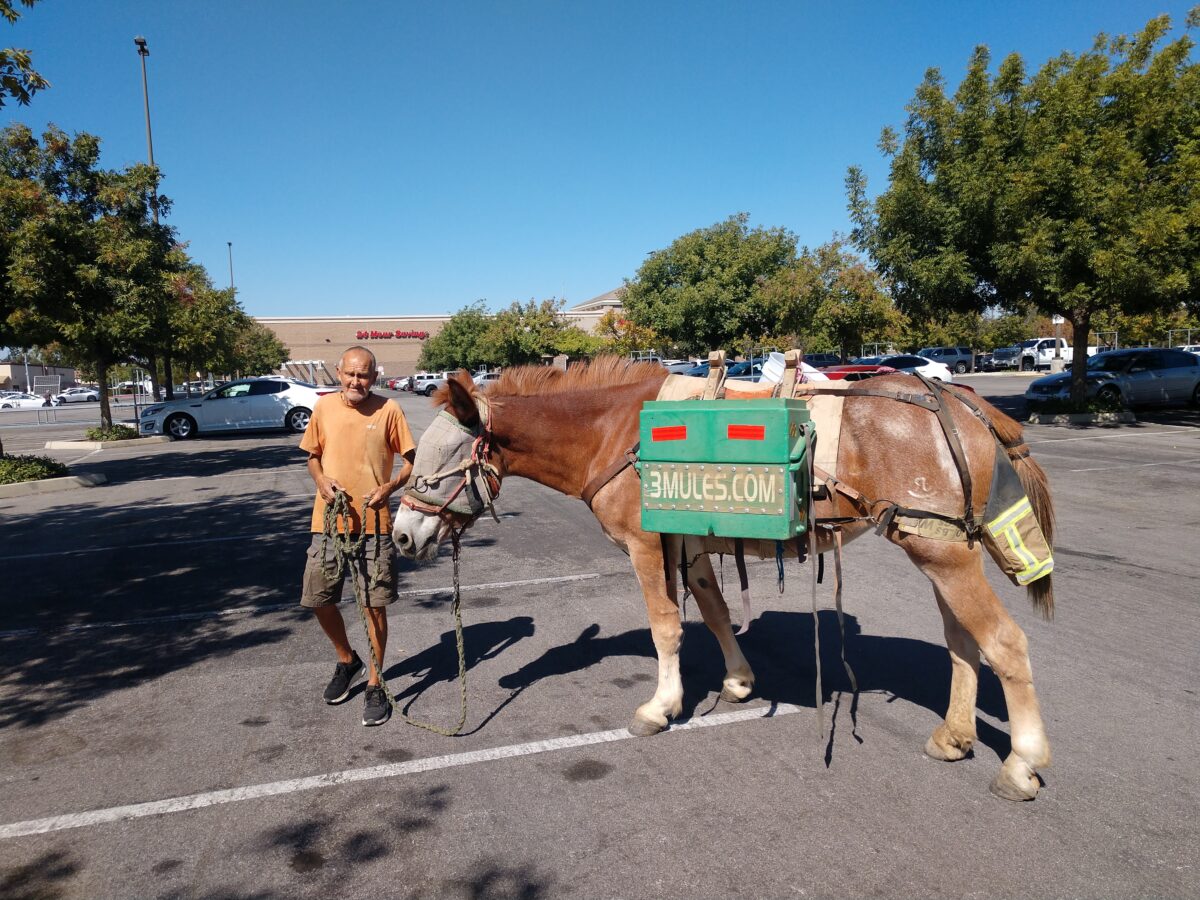
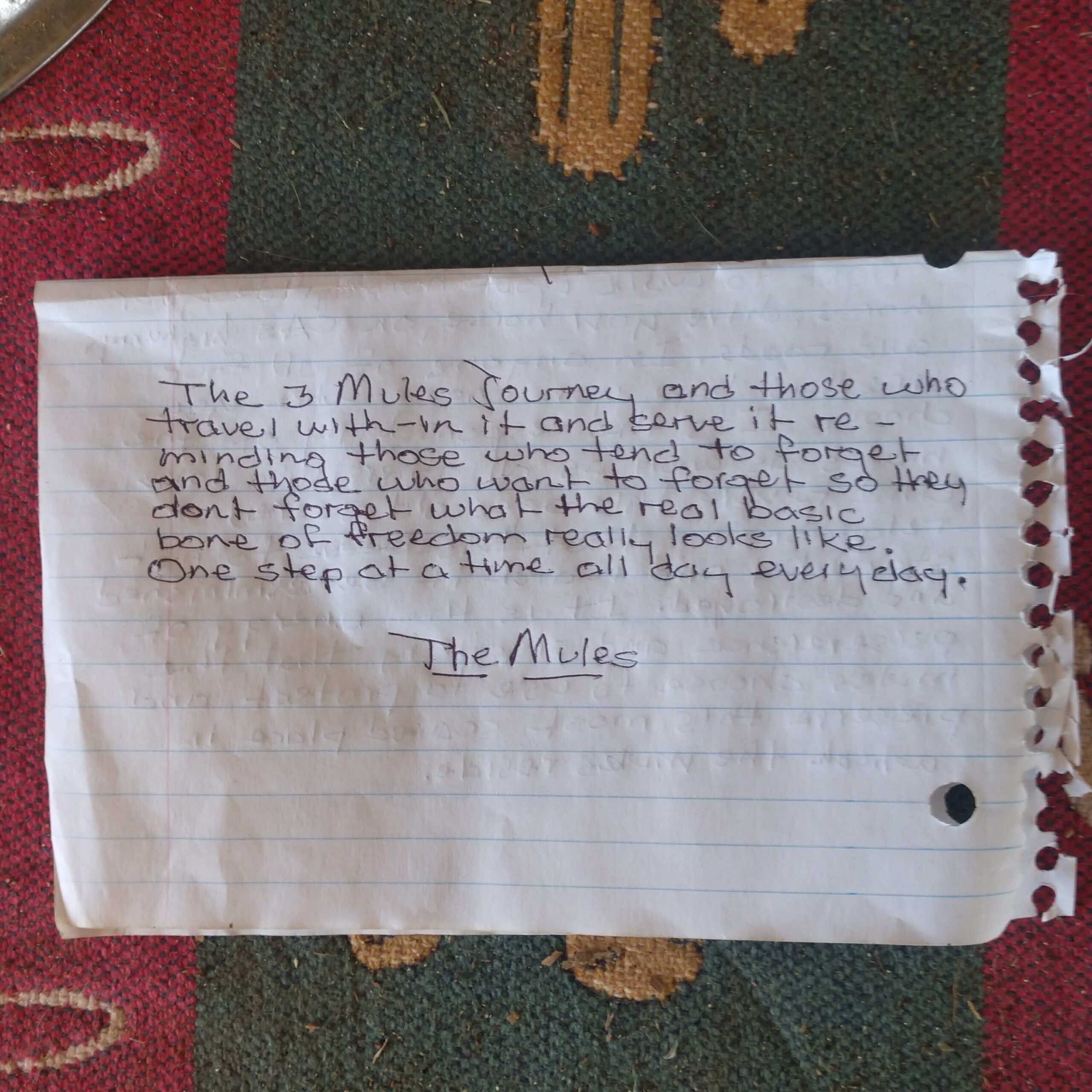
These two photos on the left depict a typical place a person stopping for the night, traveling whether by horse, bicycle or foot would look like using public space for no more than a period of 24 hours. These pictures show a stark difference between a homeless encampment that can be there for weeks, months, years, versus a persons traveling using their own power at their own speed.

On June 12, 2025 Mules sent San Jose Mayor Mahan the following letter. (We also sent the email to San Mateo Mayor Fung but did not receive a response back. Mayor Mahan’s office sent back a response to that letter. We welcome you to read it. The Mules certainly did. This letter seems to be to us the mules a long drawn out attempt to justify this law passed by San Jose to deal with the consequences of so-called homeless encampments. But nowhere in their letter responding to our letter  was there any mention or acknowledgment that the Mules or anybody else traveling under their  own power in own speed how they choose when they choose. Stopping for no more than a period of 24 hours on public land to spend the night would not be subject to the requirements and consequences of this law. 

To Mayor Mahan and Mayor Fung: 

I recently read a news article that your cities recently passed an ordinance to arrest people if they refuse offers of shelter or stop to sleep or rest outside in public spaces.  In the past, I’ve stopped at San Jose City Hall and Millbrae City Hall to hand deliver my letter requesting you to stop the use of California Penal Code 647(e) and any municipal code of similar nature that criminalizes the nomadic lifestyle, which has been practiced for all of human history and is deeply rooted in American tradition, practiced by many up to this day. 

We, the Mules, live a lifestyle of motion, never staying on public land for more than a night, always less than 24 hours. We walk, never using an automobile, leading my pack mule, carrying all my simple belongings: a one-person tent, a sleeping bag, a one-burner camp stove, a cooking pot, food, clothes, and very little else. The Mules and myself have been wandering around the Western United States for over 40 years and up and down the state of California for 12 years, going from city to city, town to town never once committing any of the offenses PC 647(e) or your municipal code was written then passed to address (i.e., the blight caused by long-term tent encampments). 

The 3 Mule Journey does not willingly engage in the living inside lifestyle, whether it be in a house, jail, barracks, etc. Instead, the Mules practice a nomadic lifestyle living outside with respect and in harmony with all that surrounds us. 

We are supported by the spiritual energy that we gather from everybody and everything that surrounds us as we walk from town to town, city to city. The energy we gather then harbors and awaits to materialize into whatever we need as we pursue our journey. This is the way of this place for those who travel and live (non-motorized traveling) in service to it. The 3 Mules Journey spreads the message of living harmoniously with the earth. This way of life is a commitment to protecting the environment and living in tune with the Natural World, one step at a time.

We are deeply concerned that using your city ordinance that criminalizes a lone traveler such as the 3 Mules or anyone else traveling in a similar way and are not committing any of the abuses that your ordinance was passed to prevent is a criminal act in and of itself. Intended or unintended, it will also reduce access and use of the public space to all citizens. To travel under their own power and their own speed, how they choose, when they choose, whether living outside as the 3 Mules do, or inside houses and tents as most people do.

When my mule and I walk through the Bay Area again as we head north in the summer and pass through again in the fall as we head south for the winter, will we be forcibly stopped by police forcing us to shelter when we obviously have no need of it? Then be arrested on a trespassing charge for refusing three times to accept that help? If your city does arrest the Mules, your city will surely face a lawsuit infused with the energy of all the people who follow the Three Mule Journey over the 12 years we have traveled up and down north and south throughout the state of California. 

I urge you to reconsider the enforcement of codes that will criminalize a lone traveler, whether traveling by horse, bicycle, foot, or any other means under their own power and speed. I look forward to your response to bring any codes having a similar effect to a more accurate and clear condition on the issues it was meant to address.

Sincerely,

The Mules 

The Mayor’s Office Response to our letter

On June 16, 2025, the Mules received the following response back from the City of San Jose Mayor’s Office. This letter seems to be to us the Mules a long drawn out attempt to justify this law passed by San Jose to deal with the consequences of so-called homeless encampments. But nowhere in their letter responding to our letter   was there any mention or acknowledgment that the Mules or anybody else traveling under their  own power in own speed how they choose when they choose. Stopping for no more than a period of 24 hours on public land to spend the night would not be subject to the requirements and consequences of this law.


Hi John,

Thank you for contacting Mayor Matt’s office. We appreciate your engagement and want to take this opportunity to clarify several important points about the Mayor’s Responsibility to Shelter proposal, especially in light of recent conversations and the spread of misinformation.

This proposal has sparked strong reactions because it’s bold, because it breaks with the status quo, and because it reintroduces something long missing from our homelessness strategy: accountability. That accountability runs both ways—government has a responsibility to offer shelter and care, and individuals have a responsibility to use it when it’s available.

The Mayor’s Responsibility to Shelter proposal stands in stark contrast to more punitive measures being adopted elsewhere. Just this week, Governor Gavin Newsom called on cities across California to ban homeless encampments on public property by introducing a model ordinance aimed at clearing such encampments. And in Fremont, leaders have already enacted one of the state’s most aggressive anti-camping bans—prohibiting tents and sleeping in most public areas, without first requiring offers of shelter.

San José is charting a more humane and effective path. Our approach emphasizes compassionate intervention and repeated offers of shelter, paired with reasonable expectations that those offers be accepted.

But with strong ideas come strong reactions — and unfortunately, a fair amount of misconception. So let’s separate myth from fact:

MYTH: This proposal criminalizes poverty and homelessness. 

FACT: It’s the exact opposite – this proposal holds people accountable for getting out of homelessness. It’s focused on engaging and intervening when people repeatedly show that they are unwilling or unable to accept a hand up and out of homelessness. 

MYTH: This proposal will put homeless people in jail. 

FACT: In Santa Clara County, people do not serve jail sentences for trespassing or most other low-level misdemeanors, which our Sheriff recently confirmed. But we can use repeat, non-violent misdemeanor charges to work with the Mental Health and Drug Courts to help compel people to engage in treatment. 

MYTH: Our shelters are dangerous, chaotic places that have lots of arbitrary rules and are places where no one wants to be. 

FACT: We’ve specifically designed our interim housing sites to be low-barrier. They are safe and dignified, with mostly private rooms with doors that lock and en-suite bathrooms. We allow people to bring their partner, pets, and possessions. We don’t have a curfew and we don’t kick people out after a predetermined number of days or months. We have separate sites for families with children. There’s a reason our sites run at nearly 95% occupancy and are effective at graduating people into more permanent housing solutions. People are much safer when they choose to come indoors than when they decide to stay on the streets.

This initiative is not about jail or punishment. It’s about intervention — reaching the most vulnerable people with repeated offers of shelter, care, and ultimately, treatment if they cannot accept help on their own.

The City’s current four-part implementation plan includes:

  1. Step one is updating our Code of Conduct to reflect that when shelter is offered, we expect people to accept it. We know there is a portion of our homeless population that is service-resistant. The percentage fluctuates by encampment, but we often find one-fifth to one-third of people who reject offers of shelter. And to these folks, we’re making it clear: if there is a place available, we expect it to be used. This is about compassion paired with accountability — recognizing that a path off the streets is both a right and a responsibility.
  2. Step two is about bringing our outreach teams in house. By centralizing these services within our Housing Department, we can improve efficiency, lower costs, and ensure that each person has a detailed case file. This means better data monitoring, more effective follow-up, and a stronger ability to track individual progress. Outreach will be smarter, more connected, and more accountable.
  3. Step three is the creation of a Neighborhood Quality of Life Unit within the San José Police Department, which was a proposal in the March Budget Message. This dedicated team will work hand-in-hand with our Housing Department to prioritize enforcement of the muni code based on real-time data. Their role will be to maintain public safety and enforce the updated Code of Conduct and quality of life crimes, whether committed by housed or unhoused residents. 
  4. Step four is working with the County to find places where our officers can bring people directly to access support services after three refusals of shelter – like the Mission St Recovery Center. We know that many of our homeless neighbors are struggling with addiction or mental health challenges that make it harder for them to make a rational decision about their own well-being. This partnership would allow us to connect them with treatment faster and more effectively. 

This isn’t about giving up on people. It’s about refusing to let them suffer. When someone repeatedly refuses shelter because they’re struggling with an addiction or untreated mental illness that is keeping them from making a rational decision about their own well-being, the City has reached its limit in the help it can provide. The County, as the provider of health and human services, must step in to provide the appropriate services, resources, and treatment. In this scenario, an arrest would get someone into the care of the County where they could receive help through a diversion program.

The alternative – letting someone languish on our streets – doesn’t help anyone. Over 200 people died on our streets last year. Our children don’t feel safe walking to school, our small businesses are being harmed, and our parks and creeks are polluted with trash and biowaste. We spend tens of millions of tax-payer dollars every year just managing the impacts of encampments. 

Unlike Governor Newsom’s proposal and Fremont’s encampment ban which emphasize enforcement first, San José is charting a middle path — one grounded in dignity, compassion, and shared responsibility. The Mayor’s proposed Responsibility to Shelter initiative is designed to be both compassionate and effective, focusing on providing shelter and services before considering enforcement. This approach ensures that we address the needs of our unhoused neighbors while maintaining public health and safety. 

Thank you again for connecting with our office.

Best, 

Leilani

Neighborhood Outreach team

The Mule’s Conclusion

A citizen in America a free country has the absolute right to freely travel move from one place to another how they choose when they choose and responsibility to do just that. This law as it has been crafted without a doubt will step out in the way and say to those who choose a life that nurtures and benefits the soul rather than the pocketbook . No go no further we’ve offered you help three times you’ve refused get off your horse get off your bike take off your backpack you’re going to jail. So the above being understood the city council and mayor of San Jose must remove the ambiguity in this law and bring clarity to it. And clearly state the stark and absolute difference between a person traveling and a person living within an encampment.

These two photos on the left of the lone traveler, traveling whether by horse, bicycle or foot using public space no more than a period of 24 hours to rest for the night, shows the stark contrast with a homeless encampment who is there with lots of belongings for more than 24 hours.

So those who are charged to enforce this homeless enchantment law will not be confused as to the stark difference between an homeless encampment and American citizens traveling freely how they choose when they choose a practice that has been revered throughout American history and still is to this day.

The Mules believe a law written with ambiguity is no accident. Ambiguity allows opinion to step up and push away facts. In my opinion you’re homeless I’ve offered you help three times you’ve refused. Get off your horse your bike put down your backpack you’re going to jail.

DEFINITION AMBIGUITY: the quality of being open to more than one interpretation, inexactness 

Share this:

Mystery Mule Man Spotted Around San Diego – And his Journey Might Change How You See the World

At the end of May, we were notified about an article that SanDiegoVille wrote about us 3 Mules. The article was titled “Mystery Mule Man Spotted Around San Diego – And his Journey Might Change How You See the World.” We don’t know who wrote the article since no name attached. It sort of sounded like an AI written article. Below, we have crossed out the inaccuracies and provided correction in bold font.

Many have reported seeing him in the past week – an older man walking the streets of San Diego with a mule in tow, sparking curiosity and social media buzz. But who is he, and what exactly is he doing? It turns out he’s not homeless, lost, or part of a stunt – he’s on a decades-long mission that challenges the very way we live.

San Diego residents may have recently spotted a man walking alongside a horse mule along the streets from Oceanside to Chula Vista and everywhere in between. He’s not lost, nor is he simply passing through – he’s living a way of life that predates freeways, smartphones, and suburban sprawl. The man is known as “Mule,” and his journey is part of the decades-long 3 Mules Project Journey – a nomadic mission through the American West to promote a life of simplicity, environmental awareness, and the sacred right to move freely across public lands.

Now in his late 70s, Mule (who also goes by Monk) has lived outdoors full-time with his mule companions for more than 35 40 consecutive years with 22 of those 40 consecutive years doing nothing else other than the sacred act of walking with his mule companions. Together, they travel by foot, covering 5 to 20 miles a day, depending on food, water, and terrain. They’ve migrated up and down California for decades, following seasonal cycles – south to San Diego in the winter, then back north through the Central Valley and up to Sacramento during warmer months.

Their presence may seem anachronistic, even eccentric, to passersby accustomed to the pace and priorities of modern urban life. But to Mule, his animals, and a growing number of followers (over 64,000 on Facebook alone), this lifestyle is a form of resistance against the encroaching sprawl he refers to as “the Megatropolis” – the unchecked spread of concrete, development, and car culture that has consumed open spaces and limited access to nature.

The 3 Mules Project Journey isn’t a performance or stunt. Mule lives entirely outdoors, foraging for food, relying on donations of oats and vegetables, and sleeping wherever he can find a quiet place that won’t land him in legal trouble. That’s harder than it sounds. California’s laws often prohibit overnight camping on public land, leading to occasional arrests and citations. He’s even been jailed and briefly committed to a psychiatric facility, as happened during an arrest in Gilroy. His mules were sent to a shelter, and he was locked up for six days before a patients-rights advocate intervened.  

Still, Mule remains committed to what he calls the “sacred act of walking,” which he believes is essential not just to individual well-being, but to the health of the planet itself.

Mule travels with the help of his equine companions, most recently a sorrel molly mule named Rosie. Over the years, other mules – Little Girl, Lady, Little Ethel, and Leroy – have come and gone, retired or passed on, but each has been part of the journey. The mules carry gear and food and graze along roadsides and fields. Mule is careful to stay within animal welfare guidelines, ensuring his mules carry no more than 20% of their body weight and are well-fed, hydrated, and monitored for health issues.

Though many assume he’s homeless, Mule insists that he’s simply “from the outside.” He doesn’t live in houses or drive cars. He exists in and with nature, embracing unpredictability, open space, and a sense of spiritual purpose. His lifestyle has drawn praise and admiration online, with thousands of followers tracking his movements and mission on the 3 Mules Facebook page and website. Some stop to offer food or water, or invite him to rest on private land for a night. Others report him to authorities, concerned about the animals or simply confused by his presence.

He’s walked the boardwalks of Venice Beach, slept under BART stations in Oakland, and traversed vast stretches of wilderness on Bureau of Land Management territory, where he’s witnessed suburban sprawl eat into spaces once left untouched. Two years ago, Mule walked the 295-mile stretch from Las Vegas to Ely, Nevada, only to turn back west when he realized how much land was disappearing. Twelve years ago, Mule was driven to walk out of Nevada, enter California, and bring the nomadic way of life into the heart of the California megatropolis. That moment shifted his focus – from wandering the wilderness alone to speaking up about the loss of public space.

Despite frequent interactions with police, Mule maintains that he stops on public lands only to rest at night for a period of less than 24 hours. He doesn’t set up permanent camp or collect garbage. “We’re not homeless. Our home is the Earth,” he says.

Mule’s attorney, Sharon Sherman, who represented him the Mules pro bono in 2013 was intrigued by the legal and philosophical implications of his way of life. “There is always a balance between people’s freedoms and the needs of a community,” she said. “Mule really made me stop and think about issues I’ve never considered before.”

For Mule, the right to walk freely is not just personal, it’s universal. “Why do you have more rights in a car than if you are walking?” he asks.

The San Diego appearance is just one stop on a continuous migration that Mule says he’ll continue “as long as he can.” And while his mission is unconventional, its message resonates with timeless urgency: to protect the natural world, to move with intention, and to remember that freedom is not something to be taken for granted – it’s something to be lived, one step at a time.

For more on the 3 Mules Project, visit 3Mules.com or follow their journey on Facebook and Instagram.

Originally published on May 29, 2025. Revised with corrections by the 3 Mules on June 6, 2025.

Share this:

Extensive Non-motorized Trail System

The California High-Speed Rail Authority in 2008 said the high-speed rail line would cost $33 billion and begin service by 2020. So far, only about 119 miles of the planned 776-mile railroad have commenced construction, and the estimated costs have soared to as much as $128 billion.

An inspector general report in February 2025 found the project was unlikely to meet its 2033 passenger service goal and identified a $6.5 billion funding gap for the Central Valley segment between Merced and Bakersfield.

An extensive bike path trail system for pedestrians, equestrians, cyclists connecting all communities to all communities all over the state could have been built for a mere pittance of what’s been wasted on this ridiculous high speed train.

The non-motorized travelers must be separated from the deadly weaponized automobile. The deadly weaponized automobile is killing non-motorized travelers at an ever-increasing rate each year. The idea that the two can coexist safely sharing the same space is proven year after year to not be possible.

Time to use California money for something worthwhile and valuable. An extensive trail path system for the non-motorized mode of travel.

Share this:

ALERT: 3 MULES Possessions Stolen in San Bruno, CA (San Mateo County)

Early morning Saturday, September 21, 2024 in San Bruno CA (San Mateo County) on San Antonio Avenue (between San Luis Ave & San Marco Ave), we were robbed. [The Monk and Rosie were not harmed.] Stolen was the Monk’s camelback backpack, fanny pack, duffle bag, and one of Rosie’s saddle bag shown in the photo. If you see these items in a dumpster or tossed aside in San Mateo County, please let us know by completing the contact form on our website or send us a private message. The contents inside these bags would be of zero value to the person who stole the bags, but is critical for an equestrian traveler. No questions asked if returned.

Temprano en la mañana del sábado 21 de septiembre de 2024 en San Bruno CA (Condado de San Mateo) en la Avenida San Antonio (entre la Avenida San Luis y la Avenida San Marco), nos robaron. Lo sustraído fue una mochila camel, una riñonera, un petate gris y una alforja. Si ve estos artículos en un contenedor de basura o tirados a un lado en el condado de San Mateo, infórmenos completando el formulario de contacto en nuestro sitio web. El contenido del interior de estas bolsas no tendría ningún valor para la persona que las robó, pero es esencial para un viajero ecuestre. No se hacen preguntas si se devuelve.

Share this:

California Penal Code 647(e) Conundrum

To City, County, and State Representatives:

I am writing to you as part of the 3 Mules Journey, a sacred nomadic lifestyle we share with the thousands of spiritual beings who have traveled and served throughout the ages in this sacred place in which the 3 Mules now reside. We never stay on public land for more than a night, always less than 24 hours. We walk, never using an automobile, leading my pack mule behind me, carrying all my simple belongings: a small one-person tent, a sleeping bag, a one-burner camp stove, a cooking pot, food, clothes, and very little else.

We are supported by the spiritual energy that we gather from everybody and everything that surrounds us as we walk from town to town, city to city. The energy we gather then harbors and awaits to materialize into whatever we need as we pursue our journey. This is the way of this place for those who travel and live (non-motorized traveling) in service to it. The 3 Mules Journey spreads the message of living harmoniously with the earth. This way of life is a commitment to protecting the environment and living in tune with the Natural World, one step at a time.

Pictured are our fellow lone travelers who the Mules connect to spiritually all over the world through time and history.

Penal Code 647(e) Conundrum
We are deeply concerned that using California Penal Code 647(e) to criminalize a lone traveler such as the 3 Mules or anyone else traveling in a similar way and are not committing any of the abuses 647(e) was passed to prevent is a criminal act in and of itself.

I urge you to reconsider the enforcement of PC 647(e) against the lone traveler, whether traveling by horse, bicycle, foot, or any other means under their own power and speed. 

Thank you for your attention to this matter. I look forward to your response and to working together to bring PC 647(e) to a more accurate and clear condition on the issues it was meant to address.

Sincerely,

The Mules 

3 Mules letter to city county and state representatives on California Penal Code 647(e) Conundrum
The Mules letter of the California Penal Code 647(e) Conundrum that we will hand deliver to all city halls that we walk by in California.
Share this:

Staying in One Place vs Being in Motion

SCHEME (1) You construct a shelter. Once done and completed you stay there you stay in one place. Your shelter can be a million dollar mansion or something as simple and inexpensive as a tent. The shelters, a mansion or a tent, differ in size and cost. But the people who live in them are basically living the same. They both leave their tent or their house then go places for varying amounts of time. Upon completing a task which draws them out of their house /tent they return. Evidence shows that both, the people who live in houses and those who live in tents, like to collect stuff. The people in houses fill up their garages and when there’s no longer space in the house or the garage they buy space at a storage facility. The people in tents because they have limited financial resources place the stuff they collect outside of their tent. Where it builds up and becomes an eyesore and objectionable to passers by. Because they don’t have the financial resources for storage.

SCHEME (2) You don’t construct a shelter you don’t stay in one place you stay in motion moving with the seasons.  The Mules fall under Scheme 2, using motion and energy to provide us what we need as we migrate with the season. Rather than building a shelter with the intention of staying in one place, The Mules bivouac for the night, most often less than 24 hours. Then we get up, pack up and stay in motion until the sun sets once again where we will bivouac for the coming night. The Mules tend not to collect stuff for it would create an unnecessary burden on our mules and ourselves and hamper our ability to stay in motion which is so essential to our survival and the nomadic way of life which we and many others practice.

Most counties in California in which the Mules travel through on a daily basis have passed no lodging laws.  California Penal Code 647(e) is a no lodging law, but it does not state the particular behaviors that the law is meant to prevent. Only using the word to “lodge” which is far too vague and unclear to enforce. 

 If the Mules and all others who practice this nomadic way of life on foot, bicycle, or pack mule, etc., are to be prosecuted using PC 647(e), those prosecuting us must prove that we are doing what this law was written, then passed, to prevent. Such as drug and alcohol abuse, violence, erecting tents and blocking sidewalks, etc. None of these behaviors are the mules guilty of. Obviously 647 (e) is not enforceable against the Mules.

The Mules

Share this:

There is a distinction between being Homeless and having a Nomadic Life

The United States Supreme Court will soon to make a decision whether to overturn Martin v. Boise, No. 15-35845 (9th Cir. 2018). Martin v. Boise says a person cannot be cited or arrested for sleeping on a public space when said person does not have “access to adequate temporary shelter.”

If Martin v. Boise is overturned the Mules will be subject to arrest and their property confiscated by any police officer that would find them resting for the night.

The Mules and their ages old nomadic way of life is about the art of moving and traveling under their own power and their own speed how they choose, when they choose. When we stop for the night in a vacant lot in a park or on the side of the road where there’s a very wide shoulder easement, the Mules stay is always less than 24 hours.

The Mules are a threat to nobody. We are quiet and peaceful. Our only purpose for stopping on public space is to rest for the night and then leave early in the morning and continue our journey and our life of motion. This country needs a Three Mule Journey. With rules and structure that will define its purpose and give every citizen the opportunity to step in and step up and make a contribution to the freedom of movement for us all. Using the unique spiritual energy that flows thur every soul.

In the past many people from all over the world have lived the nomadic way of life which the Mules live today. Some modern examples of nomads which the Mules have crossed paths include:

Davide Travelli and the 3 Mules [December 2015]

In December 2015, a gentleman that we met in California outside of Camp Pendleton named Davide Travelli, has traveled all over the world on his bicycle stopping for the night, pitching his tent, and gone in the morning. His journey still continues. You can see follow his endless journey on Facebook, Instagram, and YouTube.

Chen Guan Ming nomad

Mr. Chen Guan Ming, the gentleman from China, rode his tricycle/ rickshaw all over the world, including California. Mr. Chen was honored and welcomed all over the world for the way that he lived. Peacefully, respectfully, in harmony and balance with all that surrounded him. When Mr. Chen was done traveling for the day, he pulled off the road and slept in his tricycle/rickshaw.

Across the pond, an 82-year old woman completed an annual seven-week trek from England to the Scottish Highlands with her pack pony and pet dog. Jane Dotchin has been making the epic 600-mile trek journey every year since 1972. Heading north, Jane and her pack travel between 15 to 20 miles a day and camps outside to rest for the night. Just like the Mules, she carries everything she needs including her tent, food, a few belongings.

Davide Travelli, Mr.Chen Guan Ming, Jane Dotchin, the Three Mule Journey, and all those others who practice this life of non-motorized motion, whether all their lives or a segment of their life, will be subject to arrest and property confiscation.

The Mules and the other nomadic travelers do we create the problem and mess that the homeless encampments show above in the photos. The nomadic way of life which we practice must be separated out from the issues homelessness creates. We pack up and leave no trace as we demonstrated in the photos and video below.

Homeless are people that lose the financial resources to afford housing, and construct shanty towns with no garbage pickup, no toilet facilities, and no water. In the law, there needs to be clear rules distinguishing Nomads from Homeless that cities find causing the blight.

Those of us who practice the art of traveling under our own power and own speed should not be arrested for stopping less than 24 hrs to spend the night. A necessary act of living. Sleeping is common to all humans and living creatures, including those who are passing these laws.

The mayors of Grants Pass, Sausalito, and San Francisco, who want to overturn Martin v. Boise, offer no solution to the shanty town/people being unhoused problem, nor do they care about the consequences of them overturning Martin v. Boise. They just want to cross their fingers and make a wish, “please bring back Disneyland for me and my friends.” The rest of you can go to jail.

A clear distinction needs to be made in any proposed law between what the mayors of Sausalito, Grants Pass, and San Francisco complain about homeless encampment shanty towns that remain in one location for months versus the nomadic traveler who stops to rest for the night, packing up, leaving no trace, and continuing their journey the next morning. Sleep is necessary for all living beings. It is inhumane and criminal for lawmakers to create laws which make it a crime for nomadic travelers to stop and rest after walking or cycling all day.

Share this:

2023 / 24 California DMV Handbook

The Mules walked into Porterville to stock up on groceries. While we were there, we stopped at the California Department of Motor Vehicles (DMV) to get the 2024 California Drivers Handbook. 2024 was not available. We picked up the 2023 California Drivers Handbook. As we were thumbing through the 2023 Drivers Handbook, we noticed that there was very little attention given to an equestrian , a person riding a horse.

While there is excellent reference and mention to pedestrians, and their right to walk on California roads and highways, as well as cyclists to do the same, the equestrian, the person riding a horse was given a brief few words that were totally and completely inadequate to informing the public, that a person riding a horse has the same legal right to be on and using California roads and highways as the high-speed motorist (HSM). If you go to CA vehicle code 21759, the equestrian, a person riding a horse, as well as a person driving a horse, and a person walking a horse you will see is explicitly lined in and covered in the vehicle code.

The purpose of the California Driver’s Handbook is to educate the California driving public and all other legal users (pedestrians equestrians cyclists) as to their responsibilities and rights when driving and traveling on California’s highways and roads. Yet the mention, acknowledgement in the California Drivers Handbook of the equestrian is almost non-existent.

So what’s going on here? Is this some kind of willy nilly accident by those who wrote this California Driver’s Handbook for 2024? No. It’s no willy nilly accident of forgetfulness by those who wrote the handbook. It was done for a reason. And what’s going on is they are conditioning the public mind to view a person riding a horse, an equestrian, as somehow to be illegal on California’s roads. And then a call is made to CHP. CHP knows the scheme. They will come out and order the equestrian such as the Mules to stay off the road if you don’t comply with this illegal order they will illegally arrest the equestrian and impound your horse. Which has been done to the Mules multiple times. It’s an incremental first step towards eliminating the equestrian, person riding a horse totally from the California roads and highways. The next step is to start reducing equestrian rights under the vehicle code.

While horse owners may not want to do it themselves, walk, ride their horse on California’s dangerous roads. (Due mainly to the excessive speed California drivers are allowed to drive on California roads and highways.) Instead choose to use their horse in a recreational mode, attending various events by the use of an automobile. The act of doing, getting out on the road with your horse and riding it on that road to get to necessary places you need to go, must be preserved. It must be protected. That is where the line in the sand must be drawn against the incremental elimination of this sacred relationship between human being and horse. It’s sacred, it’s been on this earth for literally ions. And this is a real concerted attack on that relationship.

This attack on the equestrian, a person riding a horse, and the right to do so on California’s public roads, will not end there. It will not end with eliminating the equestrian right to ride California’s roads. It will morph. It will travel into your right to have access to facilities to drive your pick-up truck and horse trailer to compete and enjoy your horse. It will morph. It will travel on to every venue it can find. Because its sole purpose in the end is to destroy this sacred relationship between human being and horse which has been on this earth for eons.

Once again, I repeat myself. There is no better place to draw the line in the sand then where the Three Mules Journey resides or anybody else with similar intent, a place where no weapons are used or carried a place for those who choose to serve it by walking with respect and reverence for the ground on which they travel upon showing that basic right to walk your horse, ride your horse, drive your horse, on California’s highways and roads in any one of all four directions how you choose when you choose. It is the responsibility of the Mules as well as all others who love this ages old sacred relationship to not stand by and watch it be diminished and destroyed. It is the energy of perseverance and creativity that the Mules choose to use to protect and preserve this most sacred place in which the Mules reside.

Share this:

What is a Pedestrian?

Pictured is myself the Monk and Rosie the mule. I am a pedestrian and Rosie is livestock under my control. According to the California Vehicle Code I shall walk on the left side of the highway walking into the flow of traffic when and where practical. However, when not practical, due to circumstance such as blind curves or a lack of space, I, as a pedestrian controlling livestock, have the right to cross the road and walk on the other side for the safety of myself and Rosie and all others whom we might encounter.

Share this: